Potassium Carbonate → 3-bromo-1-methyl-4-(4-oxopiperidin-1-yl)-1H-pyrrole-2,5-dione
Reaction equation

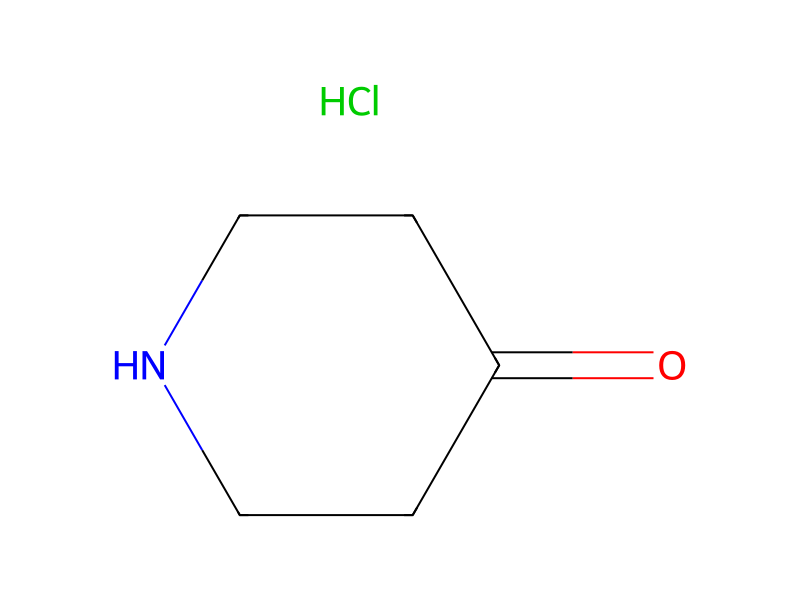
Br[C:2]1[C:3](=[O:10])[N:4]([CH3:9])[C:5](=[O:8])[C:6]=1[Br:7].Cl.[NH:12]1[CH2:17][CH2:16][C:15](=[O:18])[CH2:14][CH2:13]1.C([O-])([O-])=O.[K+].[K+]>O>[Br:7][C:6]1[C:5](=[O:8])[N:4]([CH3:9])[C:3](=[O:10])[C:2]=1[N:12]1[CH2:17][CH2:16][C:15](=[O:18])[CH2:14][CH2:13]1Participants
5




Procedure
To a stirred solution of 3,4-dibromo-1-methyl-1H-pyrrole-2,5-dione (100 mg, 0.373 mmol) in AcN (20 mL) was added piperidin-4-one hydrochloride (101 mg, 0.746 mmol) at room temperature followed by K2CO3 (102 mg, 7.46 mol). The reaction mixture was then refluxed for 2 h, diluted with water, extracted with EtOAc (2×20 mL). The combined organic layers were washed with brine, dried over anhydrous Na2SO4, filtered, and concentrated in vacuo. The crude material was purified via silica gel column chromatography eluting with 30% EtOAc in hexanes to afford 3-bromo-1-methyl-4-(4-oxopiperidin-1-yl)-1H-pyrrole-2,5-dione (100 mg, 99%) as a pale yellow solid.
Workup
- temperatureThe reaction mixture was then refluxed for 2 h
- extractionextracted with EtOAc (2×20 mL)
- washThe combined organic layers were washed with brine
- dry with materialdried over anhydrous Na2SO4
- filtrationfiltered
- concentrationconcentrated in vacuo
- customThe crude material was purified via silica gel column chromatography
- washeluting with 30% EtOAc in hexanes
Sources & evidence
- ORD record
- ord-5273271e281a4b84a9b63706ad0f8616
- Source dataset
- uspto-grants-2015_01
- Patent number
- US08933074B2
Reaction notes
Loading…