Ethylene Glycol → 4,6-Dichloro-5-(1,3-dioxolan-2-yl)pyrimidine
Reaction equation

[Cl:1][C:2]1[C:7]([CH:8]=[O:9])=[C:6]([Cl:10])[N:5]=[CH:4][N:3]=1.[CH2:11](O)[CH2:12][OH:13].C1(C)C=CC(S(O)(=O)=O)=CC=1>C1C=CC=CC=1>[Cl:1][C:2]1[C:7]([CH:8]2[O:13][CH2:12][CH2:11][O:9]2)=[C:6]([Cl:10])[N:5]=[CH:4][N:3]=1Participants
5
Reactant 3


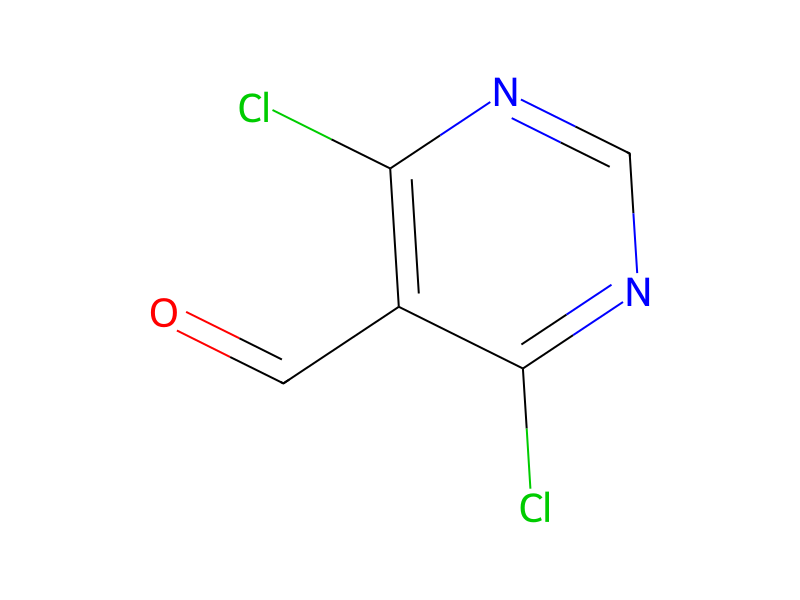
Product 1

Reagents, catalysts & solvents 1

Procedure
Compound 4,6-Dichloro-pyrimidine-5-carbaldehyde (8.6 g, 0.049 mmol), anhydrous ethylene glycol (8.2 ml) and p-Toluene-sulfonic acid (150 mg) were mixture in benzene (200 mL) and heated under reflux for 3 hours. Concentrate under high vacuum, worked up with chloroform, water, sodium bicarbonate and sodium chloride, concentrate. The reaction mixture was purified on silica (CH2Cl2) to give 4,6-Dichloro-5-[1,3]dioxolan-2-yl-pyrimidine (8.86 g, 82.5%). 1H NMR 400 MHz CDCl3 δ (ppm): 8.8 (s, 1H), 6.3 (s, 1H), 4.3 (m, 2H,), 4.1(m, 2H).
Workup
- temperatureheated
- temperatureunder reflux for 3 hours
- concentrationConcentrate under high vacuum
- concentrationconcentrate
- customThe reaction mixture was purified on silica (CH2Cl2)
Sources & evidence
- ORD record
- ord-5effa3fcf8414ddda864ee7c60683db1
- Source dataset
- uspto-grants-2015_01
- Patent number
- US08933083B2
Reaction notes
Loading…