Phosphoric Acid → L-Lysinol
Reaction equation

[NH2:1][C@H:2]([C:8](O)=[O:9])[CH2:3][CH2:4][CH2:5][CH2:6][NH2:7].S(=O)(=O)(O)O.P(=O)(O)(O)O.[H][H].[OH-].[Na+]>O.[Pt].[Re].[Ru].[Pt].[Ru].[Re]>[NH2:1][C@H:2]([CH2:8][OH:9])[CH2:3][CH2:4][CH2:5][CH2:6][NH2:7]Participants
Reactant 5


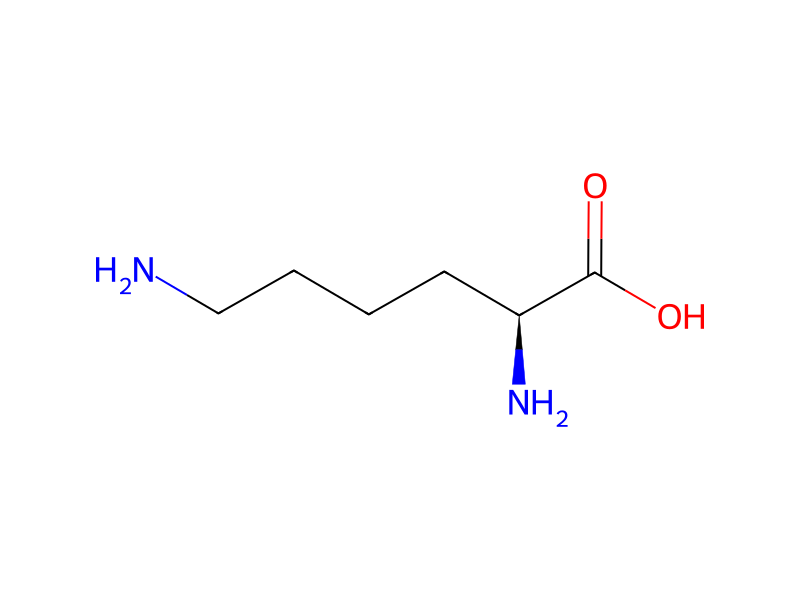


Product 1

Reagents, catalysts & solvents 5




Procedure
In particular, the process comprises charging a high pressure reactor with a solution of lysine in water, acid, and a hydrogenation catalyst. The high pressure reactor may be a batch, continuous, or semi-continuous reactor. The acid including, but not limited to sulfuric acid or phosphoric acid, is present in an amount of at least 0.5 molar equivalent of lysine or 1 molar equivalentor of lysine or 2 molar equivalent of lysine. Alternatively, the pH of the aqueous lysine solution can be adjusted with an acid to a pH in the range of 1-5 or 1.5-4 or 2-3. The catalyst is present in an amount in the range of 0.2-50% or 0.5-10% or 1-5% by weight of the total reaction mass. The hydrogenation catalyst can be chosen from those known in the art, for example ruthenium supported on carbon, platinum supported on carbon, platinum supported on titanium dioxide, or supported rhenium-ruthenium or rhenium-platinum catalysts. The process further comprises filling the reactor with hydrogen up to a pressure in the range of 0.7-14 MPa or 1.5-11 MPa or 2-9 MPa at a temperature in the range of 50-220° C. or 100-200° C. or 120-180° C. The process also comprises maintaining the pressure until ceasing of hydrogen uptake. The process further comprises cooling the reactor to room temperature and adding sodium hydroxide until pH is greater than 12. The process also comprises removing water and extracting the resulting residue, a mixture of lysinol and salt, with a solvent that will dissolve lysinol but not the salts and then removing the solvent to obtain lysinol in the form of a colorless oil. In an embodiment, the lysinol is enantioenriched (S)-lysinol. In another embodiment, the ratio of (S)-lysinol to (R)-lysinol is in the range of 99.9:0.1 to 51:49 or 98:2 to 70:30 or 95:5 to 80:20.
Workup
- customin the range of 50-220° C. or 100-200° C. or 120-180° C
- customThe process also comprises removing water
- extractionextracting the resulting residue
- additiona mixture of lysinol and salt
- dissolutionwith a solvent that will dissolve lysinol
- customnot the salts and then removing the solvent
Sources & evidence
- ORD record
- ord-73d608fb1aa6426ab2e4f1b68c53cf29
- Source dataset
- uspto-grants-2015_01
- Patent number
- US08933189B2
Reaction notes
Loading…