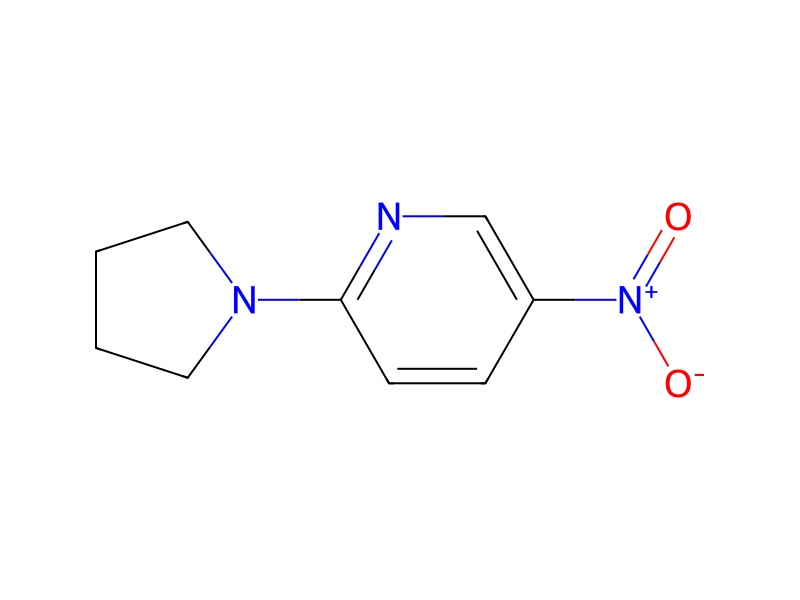
Pyrrolidine → 5-Nitro-2-(1-pyrrolidinyl)pyridine
Reaction equation

Cl[C:2]1[CH:7]=[CH:6][C:5]([N+:8]([O-:10])=[O:9])=[CH:4][N:3]=1.[NH:11]1[CH2:15][CH2:14][CH2:13][CH2:12]1>CCO>[N+:8]([C:5]1[CH:6]=[CH:7][C:2]([N:11]2[CH2:15][CH2:14][CH2:13][CH2:12]2)=[N:3][CH:4]=1)([O-:10])=[O:9]Participants
4
Reactant 2


Product 1
Reagents, catalysts & solvents 1

Conditions
- Temperature
- 70 °C
Procedure
To a slurry of 2-chloro-5-nitropyridine (10 g, 63.1 mmol) in EtOH (100 mL) at room temperature was added pyrrolidine (15.72 mL, 189 mmol) and the mixture was heated at 70° C. for 18 hours. The cooled solution was concentrated in vacuo and the residue partitioned between CH2Cl2 and 1 M NaOH. The organic layer was dried (Na2SO4), filtered and solvent removed in vacuo to give title compound (9.52 g, 78%). MS (ESI) m/z 194 (M+H)+.
Workup
- concentrationThe cooled solution was concentrated in vacuo
- customthe residue partitioned between CH2Cl2 and 1 M NaOH
- dry with materialThe organic layer was dried (Na2SO4)
- filtrationfiltered
- customsolvent removed in vacuo
Sources & evidence
- ORD record
- ord-3c263f1b98104191a83f717c9d734d24
- Source dataset
- uspto-grants-2015_01
- Patent number
- US08937150B2
Reaction notes
Loading…