Iodine → 4-Bromo-2-iodo-1-methoxybenzene
Reaction equation

[Br:1][C:2]1[CH:7]=[CH:6][C:5]([O:8][CH3:9])=[CH:4][CH:3]=1.C(O)(=O)C.C(O)(=O)C.[I:18]C1C=CC=CC=1.II.[O-]S([O-])(=S)=O.[Na+].[Na+]>C(#N)C>[Br:1][C:2]1[CH:7]=[CH:6][C:5]([O:8][CH3:9])=[C:4]([I:18])[CH:3]=1Participants
Reactant 4

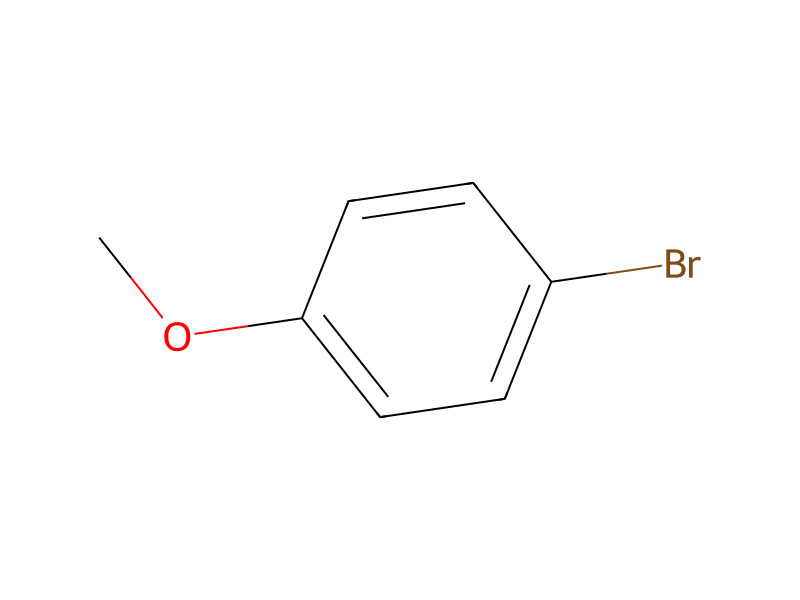


Product 1

Reagents, catalysts & solvents 1

Procedure
4-Bromo-anisole (4.417 g, 23.6 mmol) was dissolved in acetonitrile (200 mL) and placed under an argon atmosphere in the absence of light. Iodobenzene diacetate (9.18 g, 28.5 mmol) was added followed by iodine (3.6 g, 14.2 mmol). The mixture was stirred for 16 hours at ambient temperature. The mixture was then poured into 1M Na2S2O3 (200 mL) and stirred until the solution was colourless. The solution was then extracted with diethyl ether (3×100 mL). The combined organic extracts were then washed with brine, dried with Na2SO4, filtered and evaporated to dryness. The crude product was filtered through a silica gel plug eluting with heptane/ethyl acetate (3:1) (200 mL). The filtrate was concentrated and the residue was distilled using a Kugelrohr apparatus collecting the compound at 75° C., 0.01 mbar.
Workup
- stirringstirred until the solution
- extractionThe solution was then extracted with diethyl ether (3×100 mL)
- washThe combined organic extracts were then washed with brine
- dry with materialdried with Na2SO4
- filtrationfiltered
- customevaporated to dryness
- filtrationThe crude product was filtered through a silica gel plug
- washeluting with heptane/ethyl acetate (3:1) (200 mL)
- concentrationThe filtrate was concentrated
- distillationthe residue was distilled
- customcollecting the compound at 75° C.
Sources & evidence
- ORD record
- ord-86dd5d4d1e75444d9e018dbf24cbbe0c
- Source dataset
- uspto-grants-2009_11
- Patent number
- US07612068B2
Reaction notes
Loading…