1-Bromo-3-chlorobenzene → HCID 57936084, compound
Reaction equation

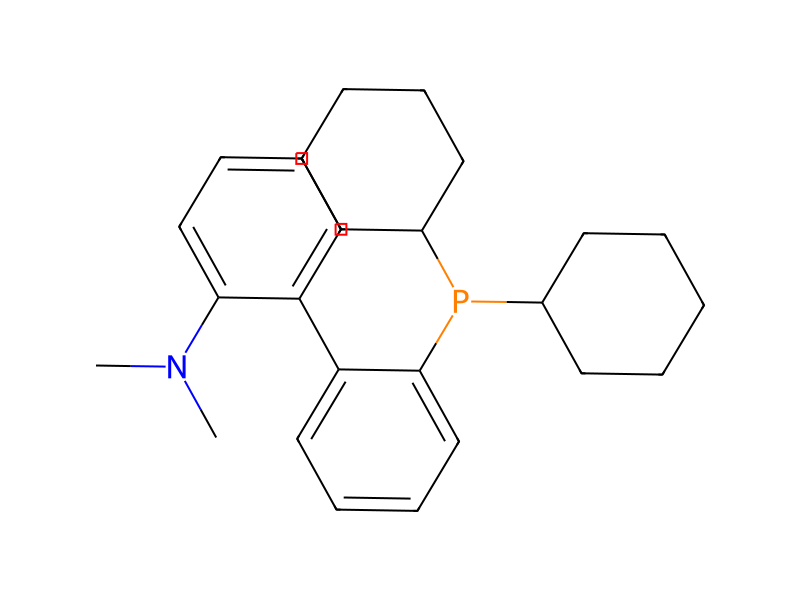
[C:1]([O-:5])(C)(C)[CH3:2].[Na+].C1(P(C2CCCCC2)[C:14]2C=CC=[CH:16][C:15]=2[C:20]2C=CC=C[C:21]=2[N:26]([CH3:28])C)CCCCC1.[Cl:35][C:36]1[CH:37]=[C:38](Br)[CH:39]=[CH:40][CH:41]=1.C(OCC)(=[O:45])C>C1(C)C=CC=CC=1>[Cl:35][C:36]1[CH:37]=[C:38]([N:26]2[CH2:28][CH2:16][CH:15]([C:14]([O:5][CH2:1][CH3:2])=[O:45])[CH2:20][CH2:21]2)[CH:39]=[CH:40][CH:41]=1Participants
6





Conditions
- Temperature
- 80 °C
Procedure
In a dried, screwcapped test tube under argon to a mixture of 240 mg (2.49 mmol) sodium tert.-butanolate, 33 mg (0.04 mmol) of tris-(dibenzylideneacetone)-dipalladium(0) and 42 mg (0.11 mmol) of 2-dicyclohexylphosphino-2′-(N,N-dimethylamino)biphenyl in 3.1 ml of toluene were added 308 mg (1.96 mmol) of ethyl piperidinelcarboxylate and 341 mg (1.78 mmol) of 3-chlorobromobenzene. The mixture was stirred with heating overnight at 80° C. After cooling, ethyl acetate was added, solid material was filtered off, the solvents were evaporated and the residue was purified by preparative RP-HPLC in a water/acetonitrile gradient to yield ethyl 1-(3-chlorophenyl)-piperidine-4-carboxylate.
Workup
- temperatureAfter cooling
- filtrationsolid material was filtered off
- customthe solvents were evaporated
- customthe residue was purified by preparative RP-HPLC in a water/acetonitrile gradient
Sources & evidence
- ORD record
- ord-558f8f6787a34f5e9323476cc8f40310
- Source dataset
- uspto-grants-2009_11
- Patent number
- US07615557B2
Reaction notes
Loading…