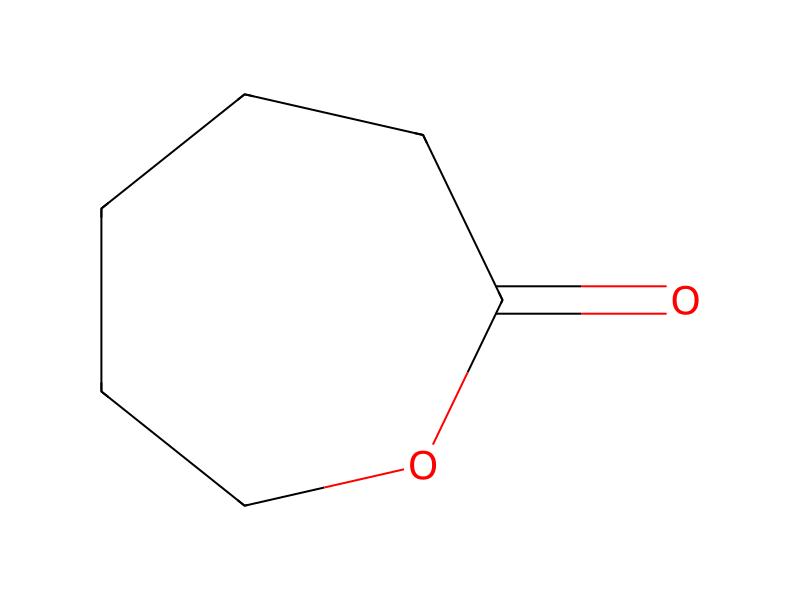
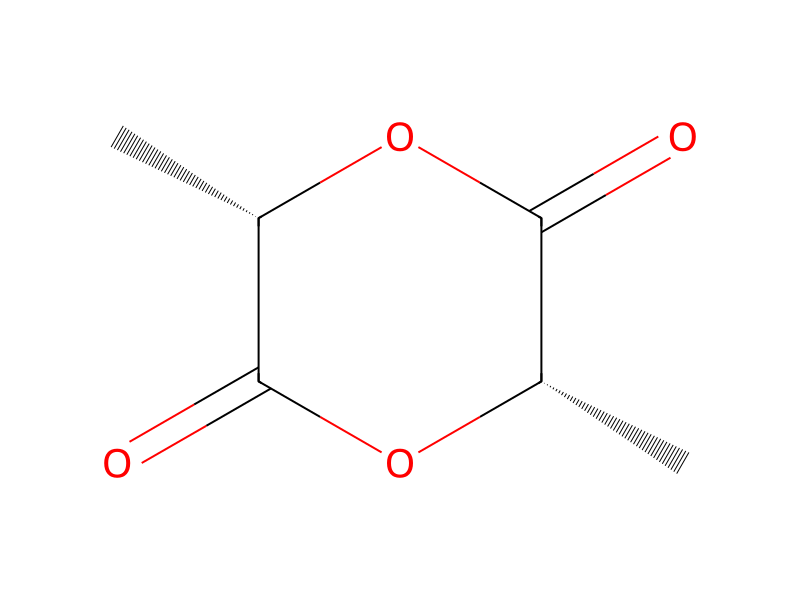
epsilon-CAPROLACTONE → L-lactide epsilon-caprolactone
Reaction equation

[CH3:1][C@@H:2]1[O:9][C:7](=[O:8])[C@H:6]([CH3:10])[O:5][C:3]1=[O:4].[C:11]1(=[O:18])[O:17][CH2:16][CH2:15][CH2:14][CH2:13][CH2:12]1>C1C=CC=CC=1>[CH3:1][C@@H:2]1[O:9][C:7](=[O:8])[C@H:6]([CH3:10])[O:5][C:3]1=[O:4].[C:11]1(=[O:18])[O:17][CH2:16][CH2:15][CH2:14][CH2:13][CH2:12]1Participants
Reactant 2
Product 1
Reagents, catalysts & solvents 1

Procedure
The procedure of Example II is repeated except that 461 grams of L-(-)-lactide, 5.4 ml of benzene containing 1.1 gram of pure stannous caprylate and 81.3 grams of epsilon caprolactone are placed in the ampoule, evacuated, sealed and heated for 15.5 hours at 136° to 140° C. The copolymer has an outstanding combination of physical properties. The copolymer is a tough, strong, clear material. It has good impact resistance and a good combination of tensile strength and elongation properties. The copolymer has GPC molecular weights of Mw = 192,200 and Mn = 44,900. The residual lactide comprises 1.15 percent. Differential thermal analysis (DTA) of the copolymer reveals a moderate amount of crystallinity with a melting point endotherm at 133° C. Molded sheets of the copolymer are clear, colorless, supple and tough. Physical properties are listed in more detail in Table 1.
Workup
- customevacuated
- customsealed
- temperatureheated for 15.5 hours at 136° to 140° C
- customat 133° C
Sources & evidence
- ORD record
- ord-bfbd781829ba474ba06bcd96b37ad392
- Source dataset
- uspto-grants-1977_11
- Patent number
- US04057537
Reaction notes
Loading…