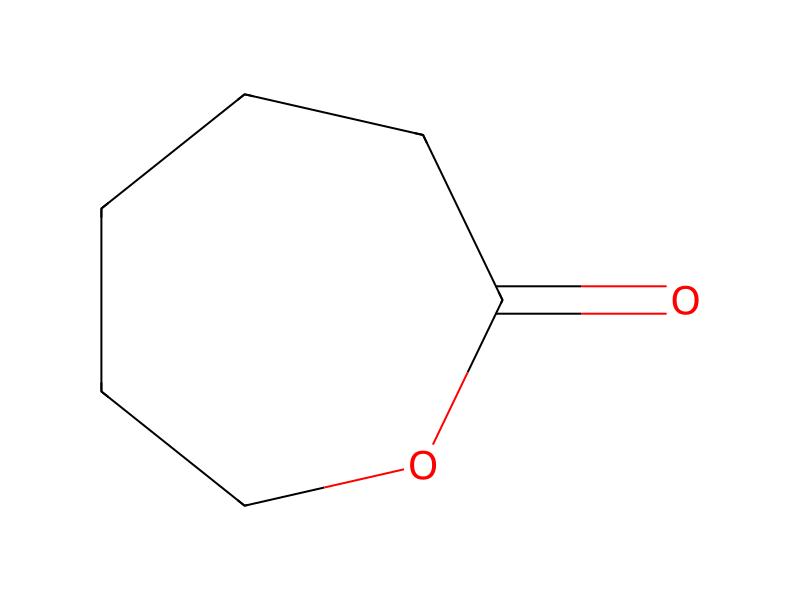
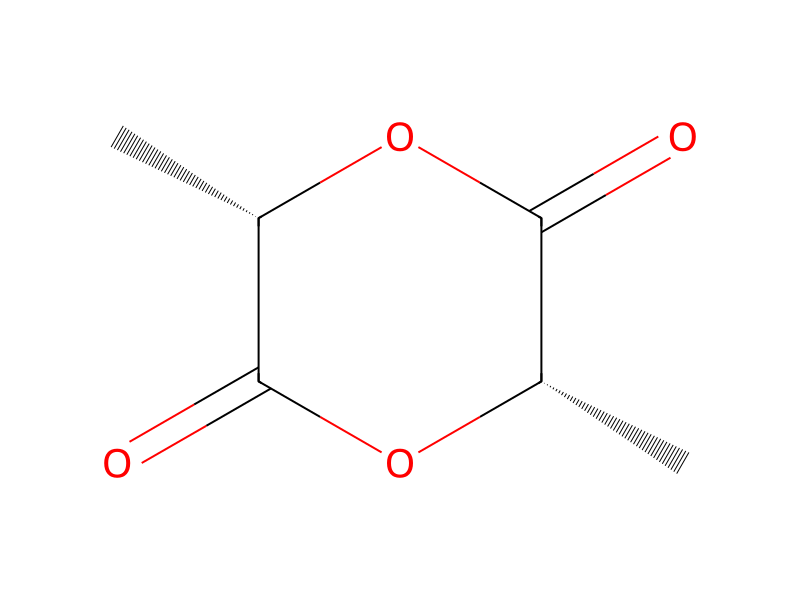
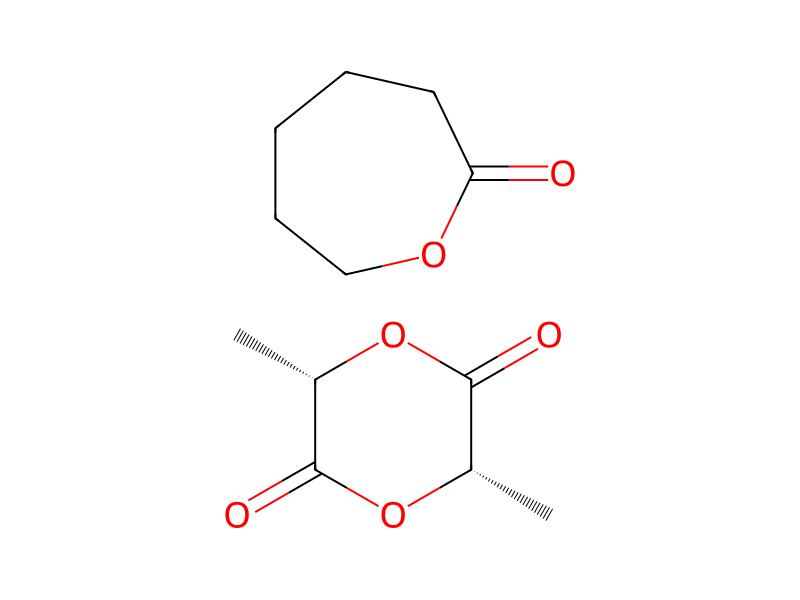
epsilon-CAPROLACTONE → L-lactide epsilon-caprolactone
Reaction equation

[CH3:1][C@@H:2]1[O:9][C:7](=[O:8])[C@H:6]([CH3:10])[O:5][C:3]1=[O:4].[C:11]1(=[O:18])[O:17][CH2:16][CH2:15][CH2:14][CH2:13][CH2:12]1>C1C=CC=CC=1>[CH3:1][C@@H:2]1[O:9][C:7](=[O:8])[C@H:6]([CH3:10])[O:5][C:3]1=[O:4].[C:11]1(=[O:18])[O:17][CH2:16][CH2:15][CH2:14][CH2:13][CH2:12]1Participants
Reactant 2
Product 1
Reagents, catalysts & solvents 1

Conditions
- Temperature
- 130 °C
Procedure
The procedure of Example II is repeated except that 500 grams of L-(-)-lactide, 55.5 grams of epsilon caprolactone and 5 ml of benzene containing 1 gram of stannous caprylate are placed in the ampoule, evacuated, sealed and heated for 18 hours at 130° C. and then 45 minutes at 160° C. The copolymer has GPC molecular weights of Mw = 223,000 and Mn = 35,700. The residual lactide comprises about 1.65 percent. Compression molded specimens are strong and transparent with a DTA melting point of 151° C. when fast cooled. Slow-cooled moldings are opaque and show an increased DTA crystallinity. The molded specimens have GPC molecular weights of Mw = 116,200 and Mn = 22,000. The residual monomer comprises about 1.8 percent. Physical properties are listed in more detail in Table 1.
Workup
- customevacuated
- customsealed
- custom45 minutes
- customat 160° C
- temperaturefast cooled
Sources & evidence
- ORD record
- ord-96625f2034a246b7b0e20e68188d5382
- Source dataset
- uspto-grants-1977_11
- Patent number
- US04057537
Reaction notes
Loading…