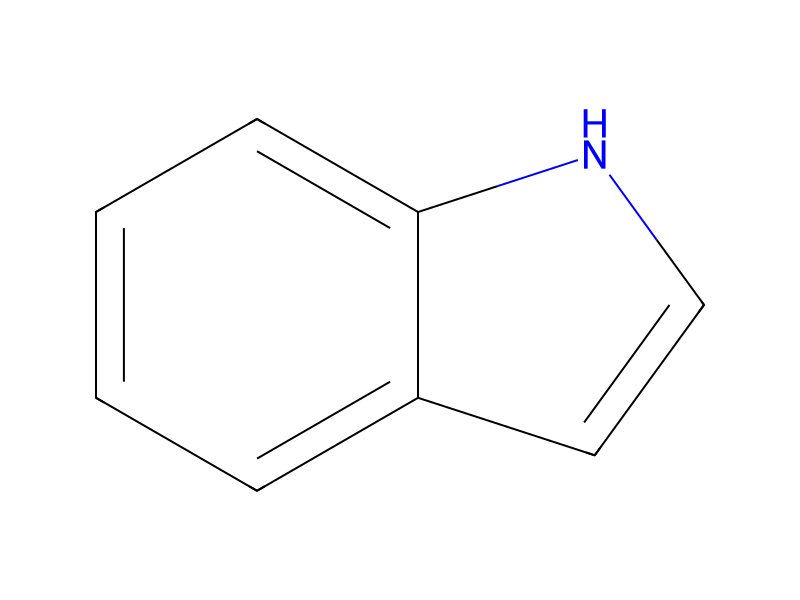
Indole → 2-1H-Indol-3-ylisothiourea, monohydroiodide
Reaction equation

[NH:1]1[C:9]2[C:4](=[CH:5][CH:6]=[CH:7][CH:8]=2)[CH:3]=[CH:2]1.[NH2:10][C:11]([NH2:13])=[S:12].[I-:14].[K+].II>CO>[CH:6]1[CH:5]=[C:4]2[C:3]([S:12][C:11]([NH2:13])=[NH:10])=[CH:2][NH:1][C:9]2=[CH:8][CH:7]=1.[IH:14]Participants
Reactant 4



Product 1

Reagents, catalysts & solvents 1

Procedure
To 240 parts of methanol is added 23.4 parts of indole, 15.2 parts of thiourea, and a sufficient amount of a 1 N aqueous solution of potassium iodide and iodine so that an equivalent of each is present for each equivalent of indole. The whole is stirred for sixteen hours, after which time the solvent is evaporated in vacuo to yield S[3-indolyl]isothiuronium iodide as colorless crystals; m.p. 214°-216°. Treatment of this product with an excess of a concentrated aqueous solution of sodium hydroxide under a nitrogen atmosphere at 80° for ten minutes, followed by cooling to room temperature yields a basic solution of 3-indolylthiol. Neutralization thereof with dilute hydrochloric acid yields as pure product, 3-indolylthiol; m.p. 100°-101°.
Workup
- customafter which time the solvent is evaporated in vacuo
Sources & evidence
- ORD record
- ord-fb2e3dd0fcd5467c97c85f9d9956673b
- Source dataset
- uspto-grants-1977_11
- Patent number
- US04059583
Reaction notes
Loading…