Sodium Hydroxide → 3-Chloro-4-methylbenzenesulfinic acid
Reaction equation

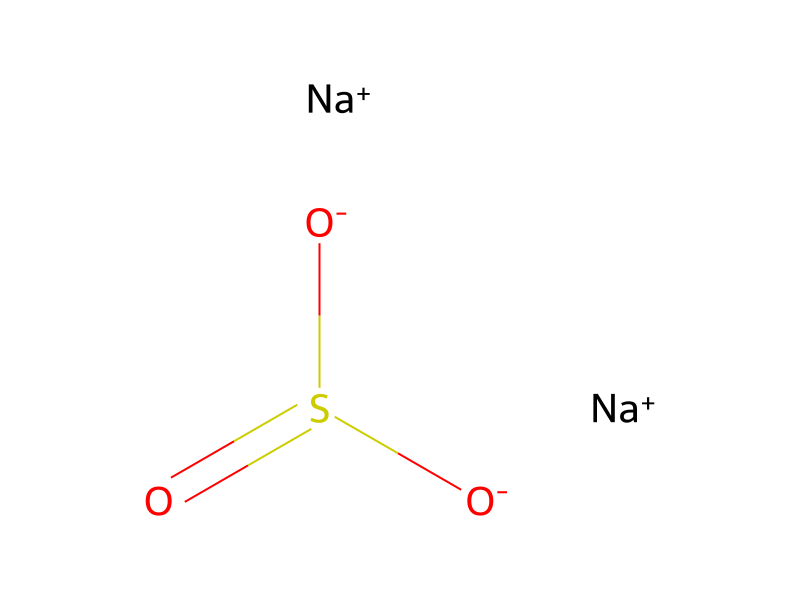
S([O-])([O-])=O.[Na+].[Na+].[Cl:7][C:8]1[CH:9]=[C:10]([S:15](Cl)(=[O:17])=[O:16])[CH:11]=[CH:12][C:13]=1[CH3:14].[OH-].[Na+]>O>[Cl:7][C:8]1[CH:9]=[C:10]([S:15]([OH:17])=[O:16])[CH:11]=[CH:12][C:13]=1[CH3:14]Participants
5
Reactant 3


Product 1

Reagents, catalysts & solvents 1

Procedure
1800 ml of water and 420 g (3.3 mol) of sodium sulfite are charged into a stirred apparatus fitted with 2 dropping funnels and a pH electrode and heated to from 50° to 55° C. Over a period of about 2 hours, 677 g (3 mol) of 3-chloro-4-methylbenzenesulfonyl chloride and at the same time 690 g of NaOH, 35% strength, are allowed to run in in such a way that a pH from 8 to 10 is always maintained. The temperature may be allowed to rise to 65° C. The reaction is complete when the pH from 8 to 10 remains constant. The 3-chloro-4-methylbenzenesulfinic acid (Na salt) produced is dissolved at 65° C. and partially crystallizes out from about 55° C.
Workup
- customfitted with 2 dropping funnels
- temperaturea pH electrode and heated to from 50° to 55° C
- temperatureis always maintained
- customto rise to 65° C
Sources & evidence
- ORD record
- ord-3472fa5a6091435eb36a75c16e6f9c08
- Source dataset
- uspto-grants-1996_03
- Patent number
- US05498798
Reaction notes
Loading…