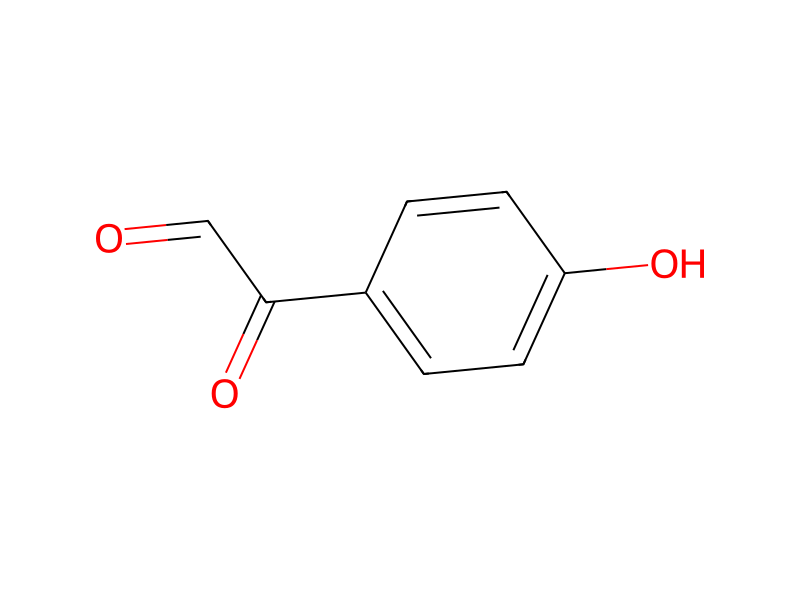
4'-Methoxyacetophenone → 4-Hydroxyphenylglyoxal
Reaction equation

[CH3:1][C:2]([C:4]1[CH:9]=[CH:8][C:7]([O:10]C)=[CH:6][CH:5]=1)=[O:3].C1(C)C(S([O-])(=O)=[O:19])=CC=CC=1.C([N+](CC)(CC)CC)C>[Pt].CO>[OH:10][C:7]1[CH:6]=[CH:5][C:4]([C:2]([CH:1]=[O:19])=[O:3])=[CH:9][CH:8]=1Participants
Reactant 2


Product 1
Reagents, catalysts & solvents 2


Procedure
In a standard undivided cell having a platinum anode and a glossy carbon cathode (33 cm2 each) there is charged 200 g methanol (65° C.), 11.3 g of 4-methoxyacetophenone (4-MAP), and 11.5 g tetraethylammonium toluene sulfonate. This electrolysis is conducted at a current density of about 30 mA/cm2 until a current passage of 50.9 Ah is charged (633% of theoretical value). According to an iodometrical determination, a current efficiency of 50% is obtained. About 150 g methanol is distilled off and the remaining solution is neutralized with aqueous NaHCO3 and extracted with ethyl acetate. The extract is dried and the solvent is removed by evaporation. The remaining oil is separated by column chromatography (silica gel, MTBE/cyclohexane =1/4). The acetal product is 6.4 g of 2,2-dimethoxy-1-[4-methoxyphenyl]-ethanale (41% based on 4-MAP). Subsequent hydrolysis at 62° C. yields 4hydroxyphenyl glyoxal (HPGO).
Workup
- additionis charged (633% of theoretical value)
- customa current efficiency of 50% is obtained
- distillationAbout 150 g methanol is distilled off
- extractionextracted with ethyl acetate
- customThe extract is dried
- customthe solvent is removed by evaporation
- customThe remaining oil is separated by column chromatography (silica gel, MTBE/cyclohexane =1/4)
- customSubsequent hydrolysis at 62° C.
Sources & evidence
- ORD record
- ord-09a21cbf1cf54092908aef72a776e0fc
- Source dataset
- uspto-grants-1996_03
- Patent number
- US05500099
Reaction notes
Loading…