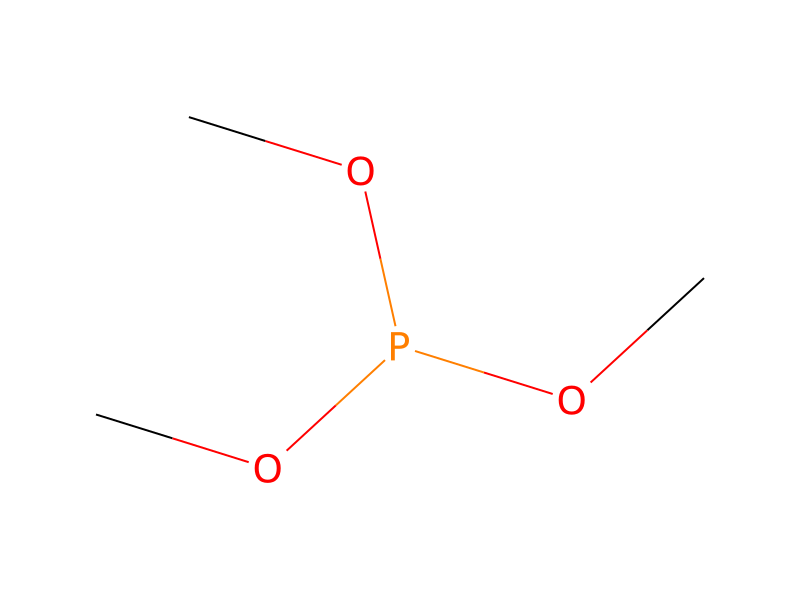
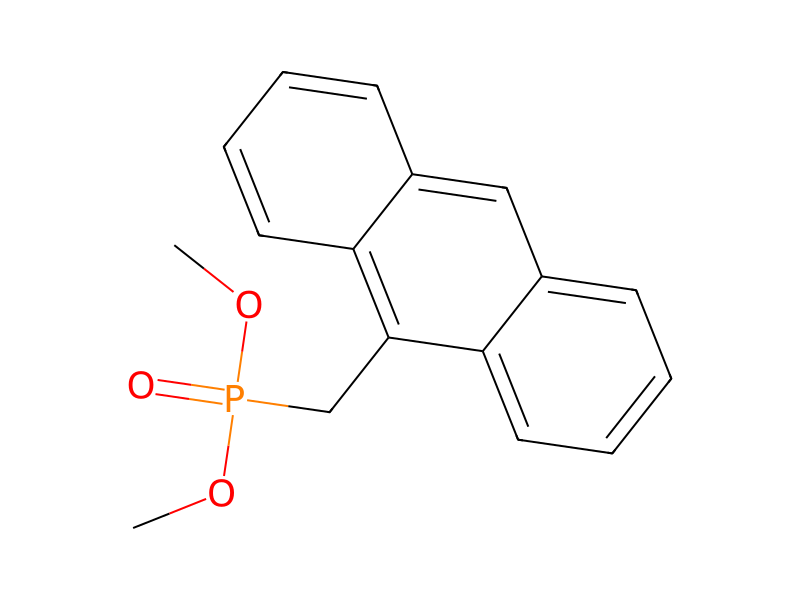
Trimethyl phosphite → (9-Anthracenylmethyl)phosphonic acid dimethyl ester
Reaction equation

Cl[CH2:2][C:3]1[C:4]2[C:9]([CH:10]=[C:11]3[C:16]=1[CH:15]=[CH:14][CH:13]=[CH:12]3)=[CH:8][CH:7]=[CH:6][CH:5]=2.[CH3:17][O:18][P:19]([O:22]C)[O:20][CH3:21]>>[CH3:17][O:18][P:19]([CH2:2][C:3]1[C:4]2[C:9]([CH:10]=[C:11]3[C:16]=1[CH:15]=[CH:14][CH:13]=[CH:12]3)=[CH:8][CH:7]=[CH:6][CH:5]=2)(=[O:22])[O:20][CH3:21]Participants
Procedure
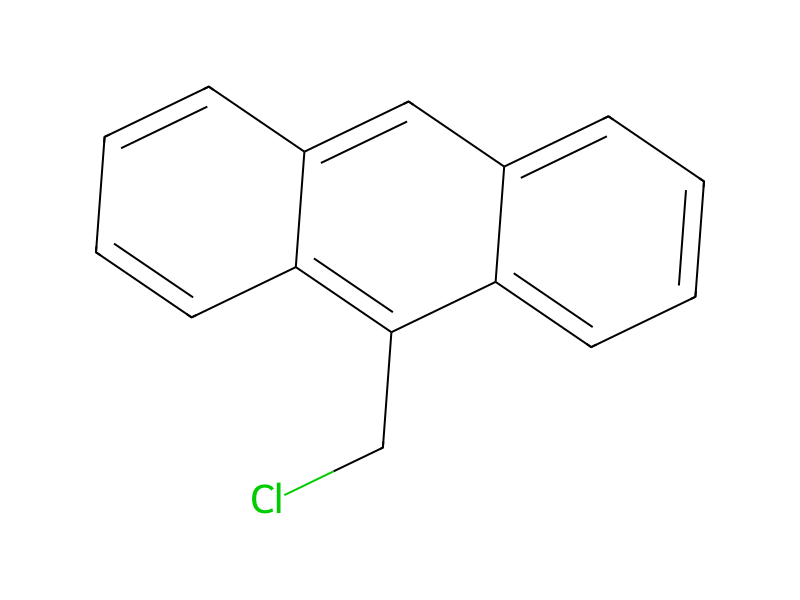
A solution of 9-(chloromethyl)anthracene (2.5 g, 0.011 M) in trimethylphosphite (5 mL, 5.26 g, 0.042 M) is heated at reflux temperature for 72 hours. Excess trimethylphosphite is removed under reduced pressure and the residue is chromatographed over silica gel (400 g, 40-63 μm, CH2Cl2, 50 mL fractions) using CH2Cl2 (60 fractions) and 2% CH3OH in CH2Cl2 for the remaining fractions. Fractions 86-93 (2.99 g) are found to contain desired material and an impurity and are rechromatographed (400 g silica gel, 40-63 μm, CH2Cl2, 50 mL fractions) using 2.5% acetone-CH2Cl2 to elute the column. Fractions 100-160 contains compound (1.495 g, 0.00498 M, 45%) as a yellow solid. Crystallization from ethyl acetate gives the title compound (1.34 g) as yellow needles, mp 152°-153° C.
Workup
- temperatureat reflux temperature for 72 hours
- customExcess trimethylphosphite is removed under reduced pressure
- customthe residue is chromatographed over silica gel (400 g, 40-63 μm, CH2Cl2, 50 mL fractions)
- customan impurity and are rechromatographed (400 g silica gel, 40-63 μm, CH2Cl2, 50 mL fractions)
- washto elute the column
- customCrystallization from ethyl acetate
Sources & evidence
- ORD record
- ord-c4a24b2cd2c645fb99c69982f88c52ab
- Source dataset
- uspto-grants-1996_03
- Patent number
- US05500417
Reaction notes
Loading…