3-Methylcatechol → Resorcinol
Reaction equation

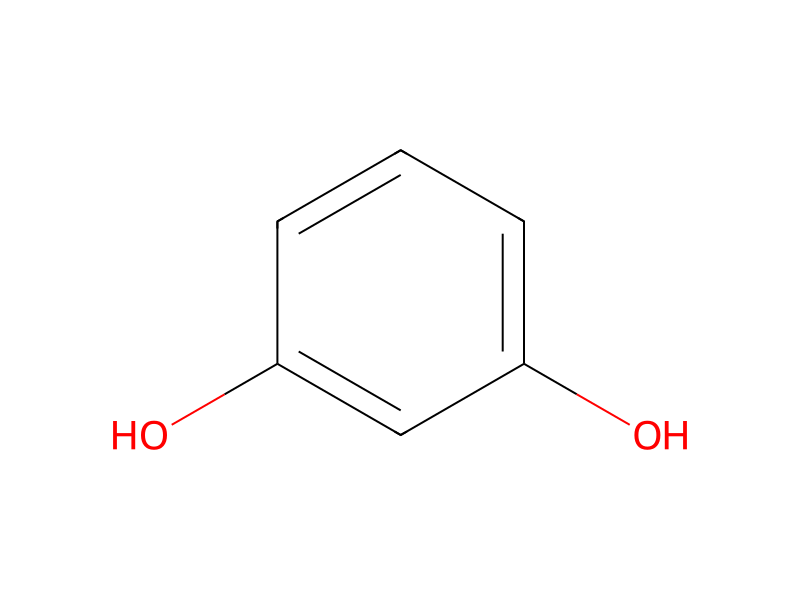
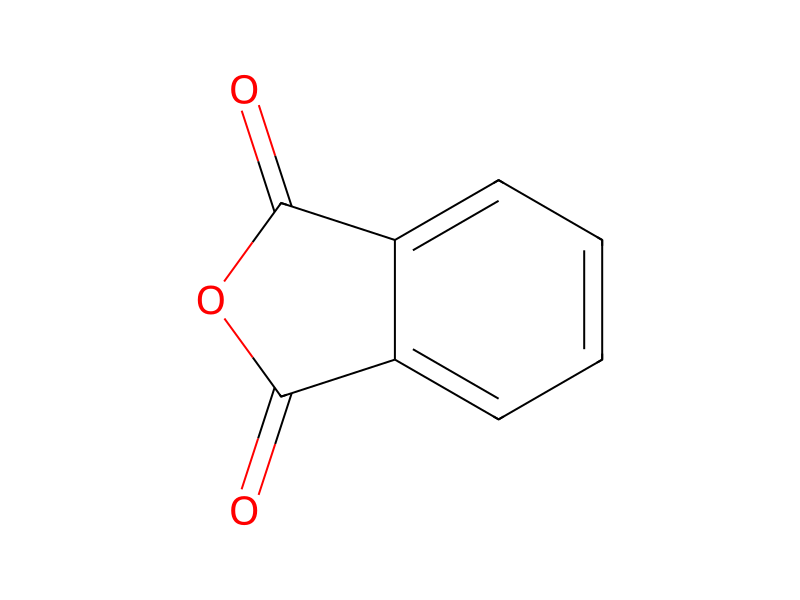
CC1C=CC=C(O)C=1O.O[C:11]1[C:24]2[C:23](=[O:25])[C:22]3[C:17](=[CH:18][CH:19]=[CH:20][CH:21]=3)[C:16](=[O:26])[C:15]=2[CH:14]=[C:13](C)[C:12]=1[OH:28].C1(=O)OC(=O)C2=CC=CC=C12.[C:40]1([CH:47]=[CH:46][CH:45]=[C:43]([OH:44])[CH:42]=1)[OH:41]>>[C:40]1([CH:47]=[CH:46][CH:45]=[C:43]([OH:44])[CH:42]=1)[OH:41].[CH:20]1[CH:21]=[C:22]2[C:23]([O:26][C:16]3([C:15]4[CH:24]=[CH:11][C:12]([OH:28])=[CH:13][C:14]=4[O:44][C:43]4[CH:42]=[C:40]([OH:41])[CH:47]=[CH:46][C:45]3=4)[C:17]2=[CH:18][CH:19]=1)=[O:25]Participants



Procedure
A single step synthesis of anthraquinone analogues (A-N) was accomplished by reacting selected phthalic anhydrides with substituted phenols in the presence of AlCl3/NaCl (FIGS. 1 and 4). The reaction between phthalic anhydride and substituted phenols such as catechol, 1,4-hydroquinone and pyrogallol produced 1,2 dihydroxy-(A), 1,4-dihydroxy-(E) and 1,2,3-trihydroxy anthraquinones (F), respectively, whereas with resorcinol afforded 1,3-dihydroxy anthraquinone (D) and 3′,6′ dihydroxyfluoran (D1). However, the reaction with 3-methyl catechol yielded 1,2-dihyroxy-3-methyl anthraquinone (B) and 1-methyl-2,3-dihydroxy anthraquinone (C) as the major and minor products, respectively. It is interesting to compare the yield of products with various substrates. The reaction of phthalic anhydride and catechol gave 50% of A whereas with 3-methyl catechol gave products B and C with 60% and 15% yield, respectively. Moreover, the reaction with 1,4-hydroquinone and pyrogallol afforded 80% of E and 75% of F, whereas with resorcinol gave 50% of D and 20% of Dl. The variation in yield was probably due to acylation at ortho and para positions to the hydroxyl groups. There is no para position free in 1,4-hydroquinone and hence the acylation was at ortho to the hydroxyl groups to afford a high yield of product E. In the reaction between pyrogallol and phthalic anhydride, the acylium ion either substituted at ortho to 1-hydroxyl or 3-hydroxyl group or para position to 2-hydroxyl group to yield a single product F. However, with 3-methyl catechol, the possible substitution of the acylium ions were either ortho or para to hydroxyl groups or ortho to the methyl group and lead to two products B and C with different yields. In the reaction between phthalic anhydride and resorcinol, the potential substitutions of the acylium ion are at positions 2, 4 and 6. The reaction did not take place at position 2 with high electron density due to steric hindrance but it was favored at positions 4 and 6 to yield D. However, with excess amount of resorcinol gave another side product D1. Interestingly, catechol gave only product A due to substitutions at positions 3 and 6. It is clear that even if the acylium ion reacts at positions 4 or 5 in catechol, A would have been the only product due to ring closures at 3 or 6 positions. Friedel-Crafts ortho bisacylation reactions were also studied in the presence of various solvents with AlCl3 (FIG. 2). Although benzene, toluene and nitrobenzene are solvents of choice for acylation reaction (Huffman, J. W., et al., J. Org. Chem., 37 487-490 (1972)), it was found that nitrobenzene was the only effective solvent for Friedel-Crafts “ortho acylation” reaction in our studies. It is important to compare the reactivity and yield of products between AlCl3/C6H5NO2 and AlCl3/NaCl melt. Even with a poor yield, AlCl3/C6H5NO2 system needed longer time (>4 h) and high temperatures such as >215 C for the reaction to complete. The reaction also was carried out with phthaloyl chloride 1a, instead of phthalic anhydride. Phthaloyl chloride 1a was prepared by treating phthalic acid with excess amount of thionyl chloride at 80 C for 2 h. The reaction was carried out under identical conditions with AlCl3/C6H5NO2. There was no improvement in the yield of the products. However, with the AlCl3/NaCl melt at 165 C, the reaction proceeded faster and gave a much higher yield (FIG. 2). The poor yield at higher temperatures was probably due to potential decomposition of phenolic compounds.
Workup
- customto yield D
Sources & evidence
- ORD record
- ord-45bcecc3271c40129f5ada534bcbb701
- Source dataset
- uspto-grants-2010_02
- Patent number
- US07658937B2
Reaction notes
Loading…