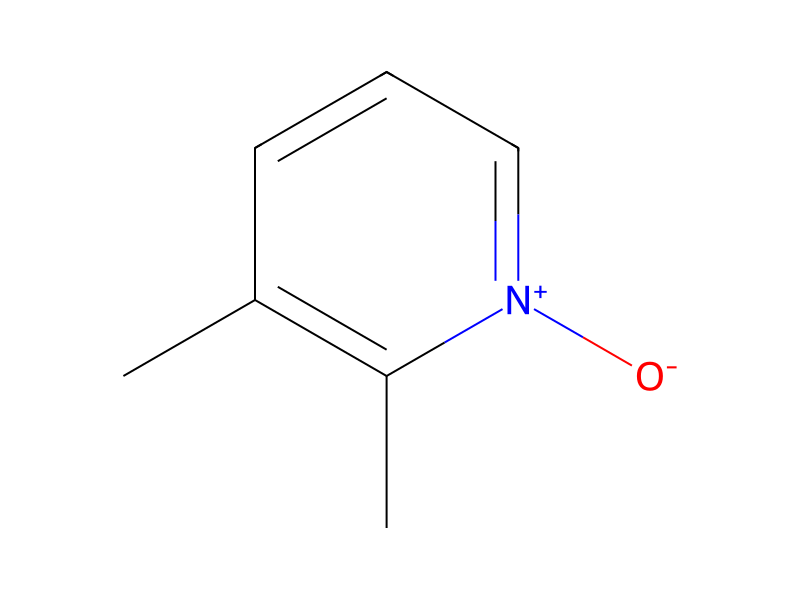
Sodium Chloride → Pyridine, 2,3-dimethyl-, 1-oxide
Reaction equation

O.O.O.O.O.O.C(O[O-])(=O)C1C(=CC=CC=1)C([O-])=[O:11].[Mg+2].[CH3:21][C:22]1[C:27]([CH3:28])=[CH:26][CH:25]=[CH:24][N:23]=1.C(=O)([O-])[O-].[K+].[K+].[Cl-].[Na+]>O>[CH3:21][C:22]1[C:27]([CH3:28])=[CH:26][CH:25]=[CH:24][N+:23]=1[O-:11]Participants





Conditions
- Temperature
- 27.5 °C
Procedure
46.2 g of magnesium monoperoxyphthalate hexahydrate in 150 ml of water were slowly added at room temperature to a solution of 11.32 ml (0.100 mole) of 2,3-dimethylpyridine and 11.2 g of potassium carbonate in 50 ml of water. The reaction was carried out at a pH of 6.5-7.0, adjusted by a solution of potassium carbonate, and the reaction mixture was stirred for three hours at a temperature of from 25 to 30° C. At the end of the reaction, the pH was adjusted to 7.5-8.0, 40 g of sodium chloride were added and the 2,3-dimethylpyridine N-oxide was extracted with methylene chloride. The extraction was repeated from saturated reaction solution. The combined organic phases were dried with sodium sulphate and concentrated to a volume of 60 ml. The yield was 97-98%, determined by HPLC.
Workup
- customAt the end of the reaction
- additionwere added
- extractionthe 2,3-dimethylpyridine N-oxide was extracted with methylene chloride
- extractionThe extraction
- dry with materialThe combined organic phases were dried with sodium sulphate
- concentrationconcentrated to a volume of 60 ml
Sources & evidence
- ORD record
- ord-3737a50aecda4f91b207bd3b462e1369
- Source dataset
- uspto-grants-2010_02
- Patent number
- US07662968B2
Reaction notes
Loading…