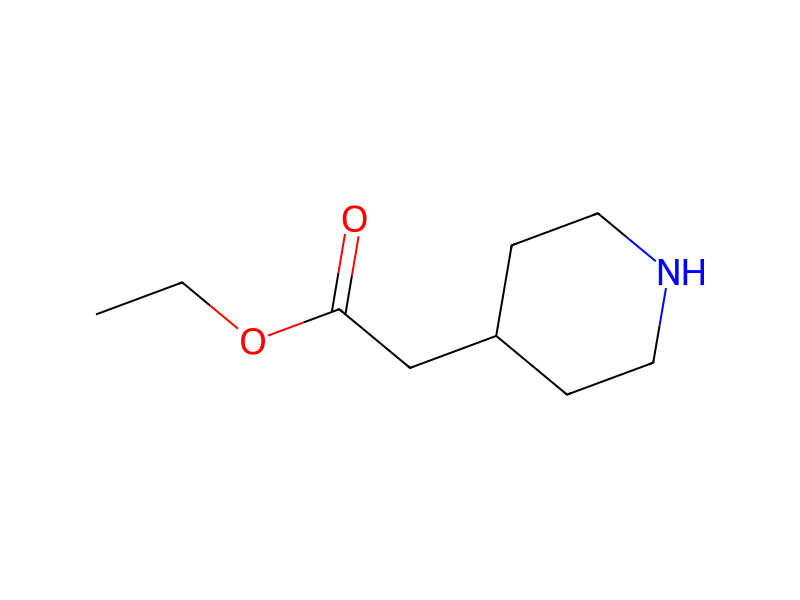
Hydrochloric Acid → Ethyl 2-(piperidin-4-yl)acetate
Reaction equation

[N:1]1[CH:6]=[CH:5][C:4]([CH2:7][C:8]([O:10][CH2:11][CH3:12])=[O:9])=[CH:3][CH:2]=1.Cl>C(O)C.[Pd]>[NH:1]1[CH2:6][CH2:5][CH:4]([CH2:7][C:8]([O:10][CH2:11][CH3:12])=[O:9])[CH2:3][CH2:2]1Participants
5
Reactant 2


Product 1
Reagents, catalysts & solvents 2


Procedure
2.0 g of ethyl 4-pyridylacetate in 20 ml of ethanol are mixed with 400 mg of palladium black (20% by weight), adjusted to pH 2 with 1 N hydrochloric acid and hydrogenated under 3 bar at room temperature for 2 days. Solids are filtered off with suction through kieselguhr, and the solvent is removed from the filtrate under reduced pressure. The residue is taken up in 50 ml of ethyl acetate and 50 ml of water. The aqueous phase is adjusted to pH 13 with 1 N sodium hydroxide solution and extracted twice with 50 ml of ethyl acetate each time. The combined organic phases are dried over magnesium sulphate, and the solvent is removed under reduced pressure. 1.21 g (58% of theory) of the product are obtained.
Workup
- filtrationSolids are filtered off with suction through kieselguhr
- customthe solvent is removed from the filtrate under reduced pressure
- extractionextracted twice with 50 ml of ethyl acetate each time
- dry with materialThe combined organic phases are dried over magnesium sulphate
- customthe solvent is removed under reduced pressure
- custom1.21 g (58% of theory) of the product are obtained
Sources & evidence
- ORD record
- ord-3d586401c3784c81bb3eb6cc223e174e
- Source dataset
- uspto-grants-2010_02
- Patent number
- US07662956B2
Reaction notes
Loading…