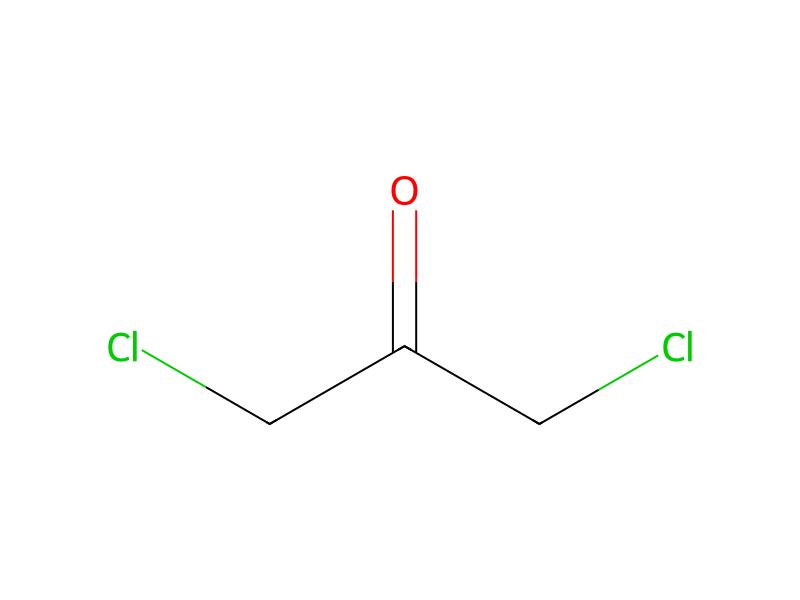
1,3-Dichloroacetone → 2-(4-Bromophenyl)-4-(chloromethyl)oxazole
Reaction equation

[Br:1][C:2]1[CH:10]=[CH:9][C:5]([C:6]([NH2:8])=[O:7])=[CH:4][CH:3]=1.[Cl:11][CH2:12][C:13]([CH2:15]Cl)=O>C(O)(C)C>[Br:1][C:2]1[CH:10]=[CH:9][C:5]([C:6]2[O:7][CH:15]=[C:13]([CH2:12][Cl:11])[N:8]=2)=[CH:4][CH:3]=1Participants
4
Reactant 2

Product 1

Reagents, catalysts & solvents 1

Procedure
4-bromo-benzamide (4.03 g, 20.11 mmol), and 1,3-dichloro-acetone (3.83 g, 30.17 mmol) are placed in a 250 mL flask and dissolved in 150 mL of isopropyl alcohol. The mixture is heated to reflux for 5 hours and cooled to ambient temperature. The reaction is concentrated to dryness. The resulting solid is triturated with diethyl ether and filtered to remove unreacted 4-bromo-benzamide. The filtrate is concentrated to the title compound as an oily solid (3.1 g) and is used without further purification. MS (m/e) 273.9 (M+1)
Workup
- temperatureThe mixture is heated
- temperatureto reflux for 5 hours
- concentrationThe reaction is concentrated to dryness
- customThe resulting solid is triturated with diethyl ether
- filtrationfiltered
- customto remove unreacted 4-bromo-benzamide
- concentrationThe filtrate is concentrated to the title compound as an oily solid (3.1 g)
- customis used without further purification
Sources & evidence
- ORD record
- ord-5058df3adc024cd0864adfce0d95c7ab
- Source dataset
- uspto-grants-2010_02
- Patent number
- US07666871B2
Reaction notes
Loading…