Triethylamine → 2-Chloro-4-(4,4,5,5-tetramethyl-1,3,2-dioxaborolan-2-yl)aniline
Reaction equation

Br[C:2]1[CH:7]=[CH:6][C:5]([NH2:8])=[C:4]([Cl:9])[CH:3]=1.C(N(CC)CC)C.[CH3:17][C:18]1([CH3:25])[C:22]([CH3:24])([CH3:23])[O:21][BH:20][O:19]1>O1CCOCC1>[Cl:9][C:4]1[CH:3]=[C:2]([B:20]2[O:21][C:22]([CH3:24])([CH3:23])[C:18]([CH3:25])([CH3:17])[O:19]2)[CH:7]=[CH:6][C:5]=1[NH2:8]Participants
5


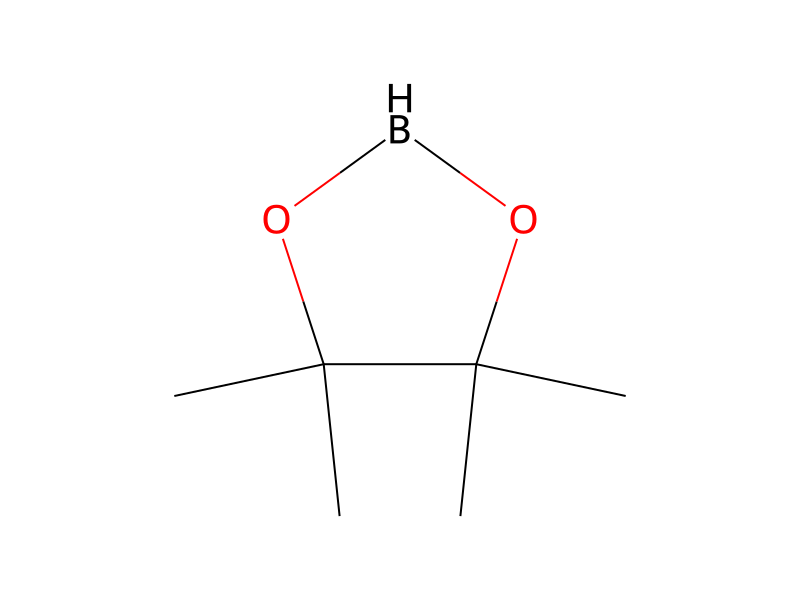


Conditions
- Temperature
- 80 °C
Procedure
Dissolve 4-bromo-2-chloro-phenylamine (4.2 g, 20 mmol) in dioxane (80 mL) in a RBF under nitrogen. Add triethylamine (10 mL, 3.6 equiv.) then sparge with nitrogen to de-gas. Add 4,4,5,5-tetramethyl-[1,3,2]dioxaborolane (8.5 mL, 2.9 equiv.) dropwise via syringe over approximately 5 minutes. Sparge an additional 5 minutes with nitrogen then add [1,1′-Bis(diphenyl-phosphino)ferrocene] dichloropalladium(II) (0.603 g, 3.7 mol %, 1:1 complex with dichloromethane). Place under nitrogen and heat at 80° C. overnight. After the reaction cools, filter via Celite® washing with hexanes. Concentrate filtrate to dryness and use crude.
Workup
- customto de-gas
- customSparge an additional 5 minutes with nitrogen
- additionthen add [1,1′-Bis(diphenyl-phosphino)ferrocene] dichloropalladium(II) (0.603 g, 3.7 mol %, 1:1 complex with dichloromethane)
- filtrationfilter via Celite®
- washwashing with hexanes
Sources & evidence
- ORD record
- ord-f2213836b98d4441815dc869478d81b8
- Source dataset
- uspto-grants-2010_02
- Patent number
- US07666879B2
Reaction notes
Loading…