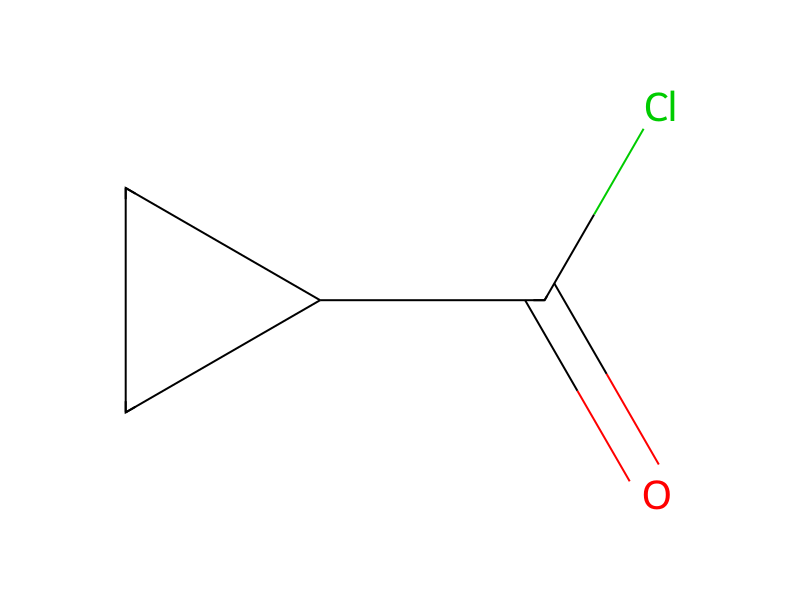
Cyclopropanecarbonyl chloride → HCID 23341635, compound
Reaction equation

[CH:1]1([C:4](Cl)=[O:5])[CH2:3][CH2:2]1.[NH2:7][C:8]1[S:9][C:10]([CH3:17])=[CH:11][C:12]=1[C:13]([O:15][CH3:16])=[O:14]>N1C=CC=CC=1>[C:13]([C:12]1[CH:11]=[C:10]([CH3:17])[S:9][C:8]=1[NH:7][C:4]([CH:1]1[CH2:3][CH2:2]1)=[O:5])([O:15][CH3:16])=[O:14]Participants
Reactant 2

Product 1

Reagents, catalysts & solvents 1

Procedure
Cyclopropanecarboxylic acid chloride (10.9 g, 0.105 mol) was added dropwise during 40 min. to a stirred solution of methyl 2-amino-5-methyl-3-thiophene-carboxylate (prepared by the method of Gewald, Chemische Berichte, 99, 94, (1966)), (17.1 g, 0.1 mol) in anhydrous pyridine (100 ml) kept at 0° C. The reaction mixture was stirred below 10° C. for the next 4 hours, at room temperature overnight, and finally under reflux for 1.5 hours. The excess of pyridine was evaporated under reduced pressure and the residue was dissolved in CHCl3 (200 ml) and extracted in turn with 2N--HCl, H2O, 2N--NaOH and H2O. The dried (Na2SO4) organic solution was evaporated and the residue was recrystallised from EtOH to yield the amide as yellow crystals (11.1 g, 46%), m.p. 121°-123° C.
Workup
- customkept at 0° C
- temperaturefinally under reflux for 1.5 hours
- customThe excess of pyridine was evaporated under reduced pressure
- dissolutionthe residue was dissolved in CHCl3 (200 ml)
- extractionextracted in turn with 2N
- dry with materialThe dried (Na2SO4) organic solution
- customwas evaporated
- customthe residue was recrystallised from EtOH
Sources & evidence
- ORD record
- ord-e7320681215843ae9647dbf5c81cd26b
- Source dataset
- uspto-grants-1980_02
- Patent number
- US04187232
Reaction notes
Loading…