Quinoline → 2,5-bis(4-cyanophenyl)furan
Reaction equation

Br[C:2]1[CH:7]=[CH:6][C:5]([C:8]2[O:9][C:10]([C:16]3[CH:21]=[CH:20][C:19](Br)=[CH:18][CH:17]=3)=[CH:11][C:12]=2C(O)=O)=[CH:4][CH:3]=1.[C:23]([Cu])#[N:24].[N:26]1C2C(=CC=CC=2)C=C[CH:27]=1>Cl>[C:27]([C:19]1[CH:18]=[CH:17][C:16]([C:10]2[O:9][C:8]([C:5]3[CH:4]=[CH:3][C:2]([C:23]#[N:24])=[CH:7][CH:6]=3)=[CH:12][CH:11]=2)=[CH:21][CH:20]=1)#[N:26]Participants
5
Reactant 3


Product 1

Reagents, catalysts & solvents 1

Procedure
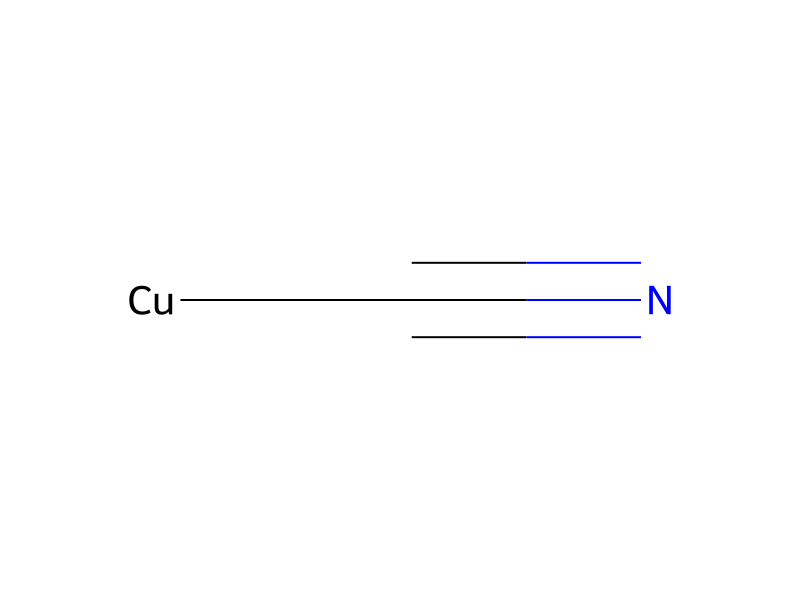
A mixture of 2,5-bis(4-bromophenyl)-3-furan carboxylic acid 0.85 g (0.002 mole), CuCN 0.45 g (0.005 mole) in 10 ml freshly distilled quinoline is heated under reflux for 3 hours. The mixture is cooled and 100 ml dilute aqueous HCl is added and the mixture is stirred for 30 min. and filtered. The solid is washed with water and then with hexane. The resultant yellow solid is dissolved in acetone and passed through an alumina (neutral) column to yield a yellow crystalline solid 0.37 g (68%) having amp of 293°-295° C. The product is identical with that described in Example 1.
Workup
- temperatureis heated
- temperatureunder reflux for 3 hours
- temperatureThe mixture is cooled
- filtrationfiltered
- washThe solid is washed with water
- dissolutionThe resultant yellow solid is dissolved in acetone
Sources & evidence
- ORD record
- ord-783162db3dff460eb7812e83cb60089d
- Source dataset
- uspto-grants-1997_02
- Patent number
- US05602172
Reaction notes
Loading…