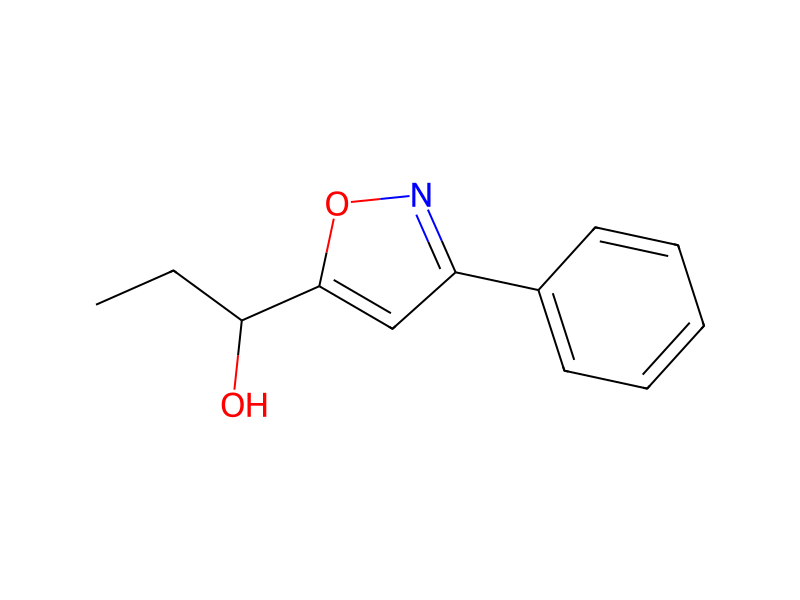
Benzene → 5-(1-Hydroxypropyl)-3-phenylisoxazole
Reaction equation

C1(C(NCl)=[O:8])C=CC=CC=1.[CH:11]#[C:12][CH:13]([OH:16])[CH2:14][CH3:15].C([N:19]([CH2:22][CH3:23])CC)C.[CH:24]1C=[CH:28][CH:27]=[CH:26][CH:25]=1>>[OH:16][CH:13]([C:14]1[O:8][N:19]=[C:22]([C:23]2[CH:28]=[CH:27][CH:26]=[CH:25][CH:24]=2)[CH:15]=1)[CH2:12][CH3:11]Participants
5




Procedure
Dissolved in 200 ml of benzene were 18.5 g (0.12 mol) of benzenehydroxamic acid chloride synthesized in accordance with a known process [J. Org. Chem., 45, 3916 (1980)] and 10.0 g (0.12 mole) of 1-pentyne-3-ol, followed by the dropwise addition of 18 g (0.18 mol) of triethylamine under ice cooling. After they were reacted under reflux for 10 hours, the reaction mixture was washed with water and the organic layer was dried over anhydrous sodium sulfate. The solvent was distilled off under reduced pressure. The resulting residue was purified by chromatography on a silica gel column (eluent: chloroform), whereby 5-(1-hydroxypropyl)-3-phenylisoxazole was obtained as colorless crystals.
Workup
- customAfter they were reacted
- temperatureunder reflux for 10 hours
- washthe reaction mixture was washed with water
- dry with materialthe organic layer was dried over anhydrous sodium sulfate
- distillationThe solvent was distilled off under reduced pressure
- customThe resulting residue was purified by chromatography on a silica gel column (eluent: chloroform)
Sources & evidence
- ORD record
- ord-72b138b7494d4b02a1e7c20647ea9ca9
- Source dataset
- uspto-grants-1997_02
- Patent number
- US05602160
Reaction notes
Loading…