Isopropanol → 3-Benzoyl-5-propionylisoxazole
Reaction equation

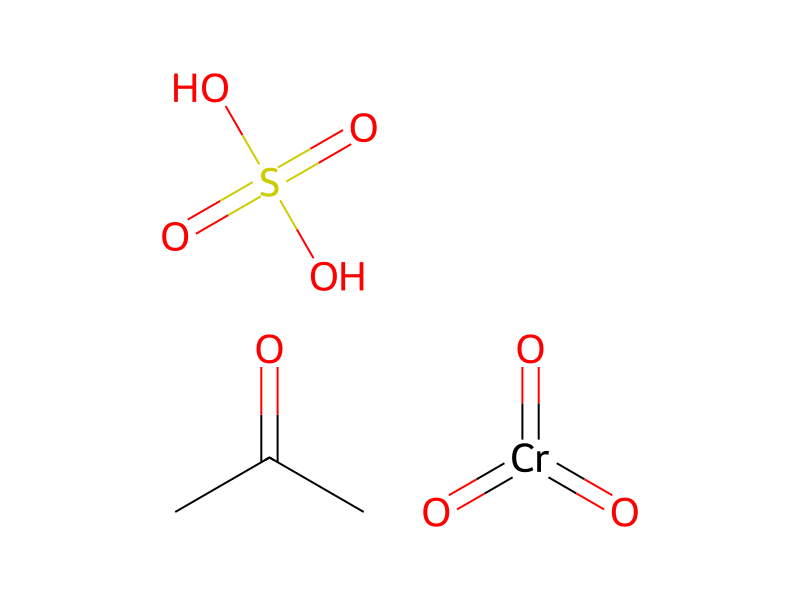
[C:1]([C:9]1[CH:13]=[C:12]([CH:14]([OH:17])[CH2:15][CH3:16])[O:11][N:10]=1)(=[O:8])[C:2]1[CH:7]=[CH:6][CH:5]=[CH:4][CH:3]=1.BrC1C=C(C(=O)CC)ON=1.C(O)(C)C>CC(C)=O.CC(C)=O.OS(O)(=O)=O.O=[Cr](=O)=O>[C:1]([C:9]1[CH:13]=[C:12]([C:14](=[O:17])[CH2:15][CH3:16])[O:11][N:10]=1)(=[O:8])[C:2]1[CH:3]=[CH:4][CH:5]=[CH:6][CH:7]=1Participants



Procedure
Reacted under reflux for 2 hours were 5.0 g (27.3 mmol) of benzoylacetohydroxamoyl chloride prepared by a known process [J. Org. Chem., 409 (1942)] and 5.0 g (59.5 mmol) of 1-pentyne-3-ol. The reaction mixture was added into water, followed by extraction with ethyl ether. The extract was concentrated and then purified by silica gel chromatography (eluent: chloroform), whereby the title compound, namely, 3-benzoyl-5-(1-hydroxypropyl)isoxazole was obtained. It was dissolved in acetone, to which the Jones' reagent was added dropwise under ice cooling so that it was oxidized from the alcohol form to a ketone form. Isopropyl alcohol was added to the reaction mixture. After an insoluble material was filtered off, the solvent was distilled off so that 3-benzoyl-5-propionylisoxazole was obtained as colorless crystals.
Workup
- additionwas added dropwise under ice cooling so that it
- filtrationAfter an insoluble material was filtered off
- distillationthe solvent was distilled off so that 3-benzoyl-5-propionylisoxazole
- customwas obtained as colorless crystals
Sources & evidence
- ORD record
- ord-6f0d9b5f9968492c8f1c15cef014cdde
- Source dataset
- uspto-grants-1997_02
- Patent number
- US05602160
Reaction notes
Loading…