Hydrogen Peroxide → Sodium percarbonate
Reaction equation

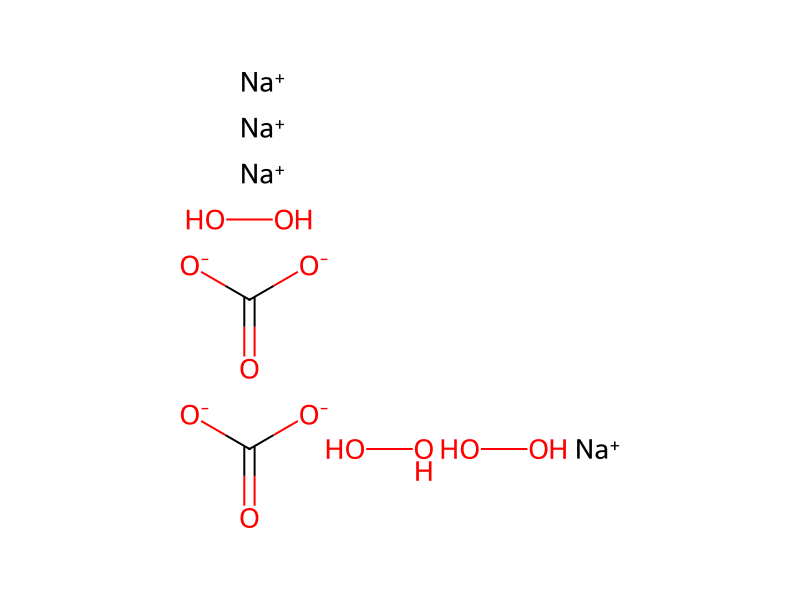
[OH:1][OH:2].[C:3]([O-:6])([O-:5])=[O:4].[Na+:7].[Na+].[Na+].[Cl-].[Si]([O-])([O-])([O-])[O-].[Na+].[Na+].[Na+].[Na+]>O>[C:3]([O-:6])([O-:5])=[O:4].[C:3]([O-:6])([O-:5])=[O:4].[OH:1][OH:2].[OH:1][OH:2].[OH:1][OH:2].[Na+:7].[Na+:7].[Na+:7].[Na+:7]Participants
6
Reactant 4




Product 1
Reagents, catalysts & solvents 1

Procedure
Sodium percarbonate was prepared as follows: 127 g of 50% aqueous solution of hydrogen peroxide and 375 g of 30% aqueous solution of Na2CO3 were simultaneously added to a mother liquor containing 7.5 g of Na2CO3, 55 g of NaCl, 200 g of water and 10 to 1000 ppm of organic polymer (tables 1 and 2), for one hour at room temperature and by stirring at a rate of 142 rpm. The aqueous solution of hydrogen peroxide had been stabilized with an aqueous solution of sodium silicate (1.84 g of sodium silicate had been dissolved in 5 g of water).
Sources & evidence
- ORD record
- ord-bfd419a8a5d94cb0bcfae542c03b4bfa
- Source dataset
- uspto-grants-1997_02
- Patent number
- US05603911
Reaction notes
Loading…