N-vinyl-2-pyrrolidone → DMAPMA n-Octadecyl Methacrylate
Reaction equation

[CH:1]([N:3]1CCC[C:4]1=O)=C.[CH:9]([CH:11]1[CH2:18][CH2:17][CH2:16][CH2:15][NH:14][C:12]1=[O:13])=C.CN(CCCC=C(C)C(N)=O)C.[C:31]([O:36][CH2:37][CH2:38][CH2:39][CH2:40][CH2:41][CH2:42][CH2:43][CH2:44][CH2:45][CH2:46][CH2:47][CH2:48][CH2:49][CH2:50][CH2:51][CH2:52][CH2:53][CH3:54])(=[O:35])[C:32]([CH3:34])=[CH2:33]>C(O)C>[CH3:9][C:11]([C:12]([NH:14][CH2:15][CH2:16][CH2:17][N:3]([CH3:4])[CH3:1])=[O:13])=[CH2:18].[C:31]([O:36][CH2:37][CH2:38][CH2:39][CH2:40][CH2:41][CH2:42][CH2:43][CH2:44][CH2:45][CH2:46][CH2:47][CH2:48][CH2:49][CH2:50][CH2:51][CH2:52][CH2:53][CH3:54])(=[O:35])[C:32]([CH3:34])=[CH2:33]Participants
Reactant 4
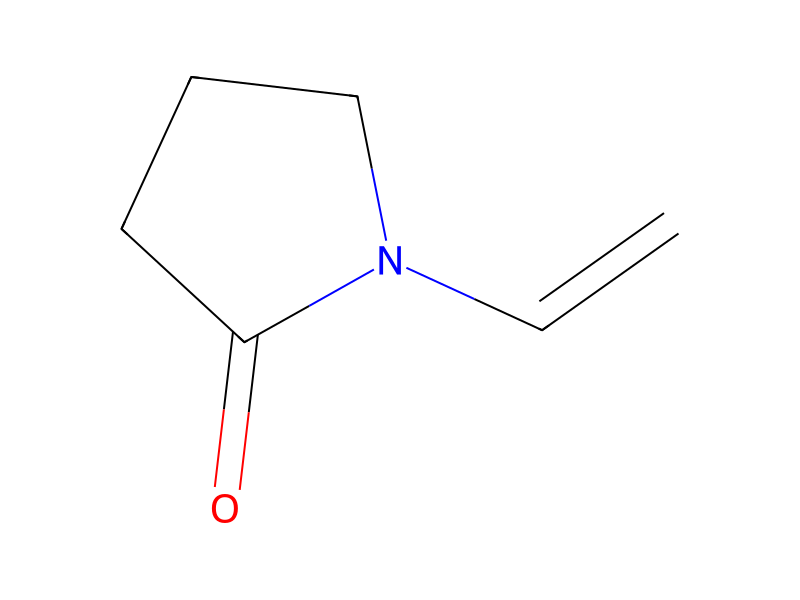


Product 1

Reagents, catalysts & solvents 1

Conditions
- Temperature
- 68 °C
Procedure
Vinyl pyrrolidone (55.6 g), vinyl caprolactam (577.5 g), dimethylaminopropyl methacrylamide (DMAPMA) (42.6 g), n-octadecyl methacrylate (33.9 g) and ethanol (867.2 g) were charged into a 2-liter water-jacketed resin flask. The reaction flask was equipped with a condenser, a thermometer, a septum (for catalyst addition), an anchor-type metal stirrer, and a nitrogen sparge tube. Nitrogen was bubbled through the solution while the resin flask was heated to 68° C. using hot water circulating through the jacketed flask. After an additional half-hour of degassing at reflexing, a first shot of Lupersol 11 (0.25 ml) was injected into the flask. Subsequently, Lupersol 11 additions were made at 10, 40, 70, 100, 140, 180 and 240 minutes after the first addition. The reaction temperature was then brought up to 75° C. and held for an additional 5 hours, then cooled to room temperature and discharged.
Workup
- customThe reaction flask was equipped with a condenser
- additiona thermometer, a septum (for catalyst addition)
- customan anchor-type metal stirrer, and a nitrogen sparge tube
- customNitrogen was bubbled through the solution while the resin flask
- customAfter an additional half-hour of degassing
- customwere made at 10, 40, 70, 100, 140, 180 and 240 minutes
- additionafter the first addition
- customwas then brought up to 75° C.
- temperaturecooled to room temperature
Sources & evidence
- ORD record
- ord-c8ae15962ee54485b7920f023876a9d9
- Source dataset
- uspto-grants-1997_02
- Patent number
- US05603919
Reaction notes
Loading…