4,5-Diaminopyrimidine → 4-Amino-5-[(1-t-butoxycarbonylpiperidin-4-yl)amino)pyrimidine
Reaction equation

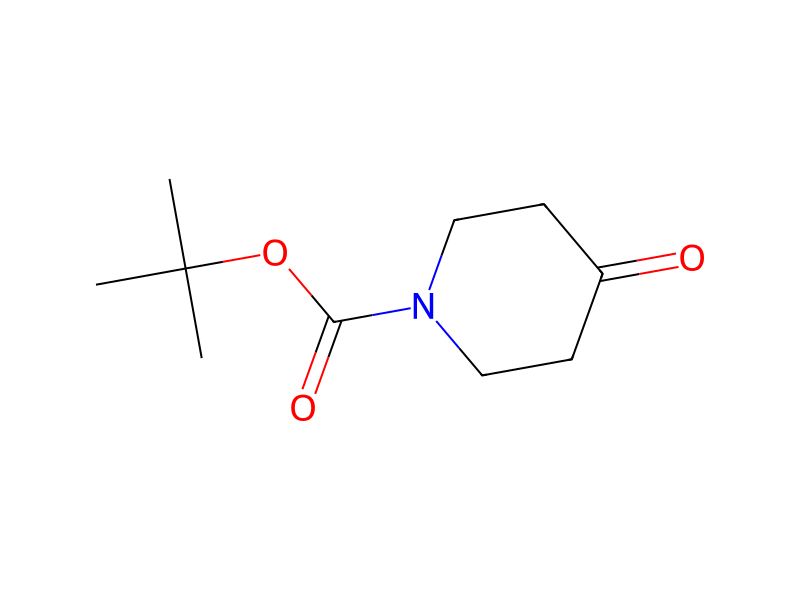
[NH2:1][C:2]1[C:7]([NH2:8])=[CH:6][N:5]=[CH:4][N:3]=1.[C:9]([O:13][C:14]([N:16]1[CH2:21][CH2:20][C:19](=O)[CH2:18][CH2:17]1)=[O:15])([CH3:12])([CH3:11])[CH3:10].C(O[BH-](OC(=O)C)OC(=O)C)(=O)C.[Na+]>ClC(Cl)C>[NH2:1][C:2]1[C:7]([NH:8][CH:19]2[CH2:20][CH2:21][N:16]([C:14]([O:13][C:9]([CH3:12])([CH3:11])[CH3:10])=[O:15])[CH2:17][CH2:18]2)=[CH:6][N:5]=[CH:4][N:3]=1Participants
5




Procedure
A mixture of 4,5-diaminopyrimidine (1.0 g, 9.1 mmol), N-(t-butoxycarbonyl)-4-piperidone (3.0 g, 15 mmol) and sodium triacetoxyborohydride (1.2 g, 5.6 mmol) in dichloroethane (60 mL) was stirred at room temperature for 3 d. The reaction was partitioned between chloroform (200 mL) and 3N sodium hydroxide (30 mL). After drying over magnesium sulfate, the organic phase was concentrated to give the title compound as a tan gum. MS 294 (M+1)
Workup
- customThe reaction was partitioned between chloroform (200 mL) and 3N sodium hydroxide (30 mL)
- dry with materialAfter drying over magnesium sulfate
- concentrationthe organic phase was concentrated
Sources & evidence
- ORD record
- ord-5b3b868414064e9192be482ea0ca5b96
- Source dataset
- uspto-grants-2009_01
- Patent number
- US07476665B2
Reaction notes
Loading…