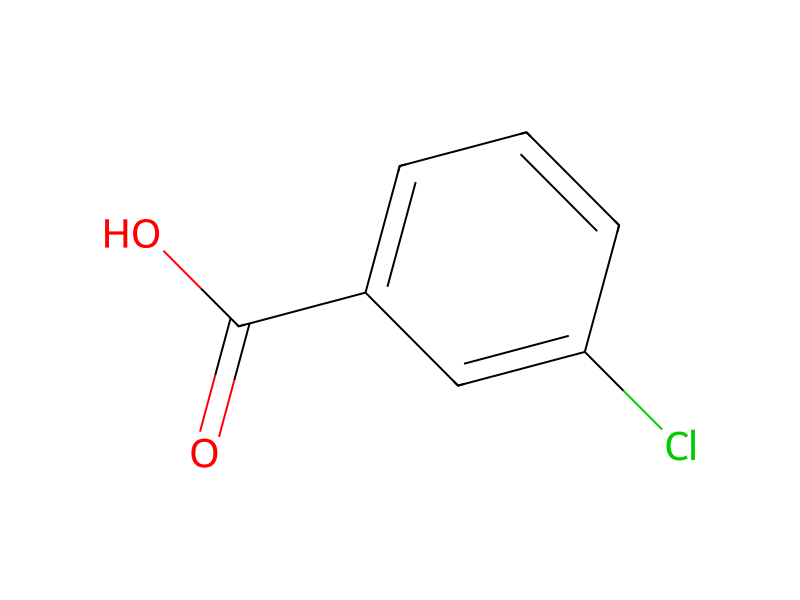
3-Chlorobenzoic Acid → HCID 22107138, compound
Reaction equation

[C:1]1([CH2:7][CH2:8][CH2:9][C:10]2[CH:15]=[CH:14][C:13](C(=O)C)=[CH:12][CH:11]=2)[CH:6]=[CH:5][CH:4]=[CH:3][CH:2]=1.ClC1C=CC=[C:22]([C:26]([O:28]O)=[O:27])C=1.ClC1C=C(C=CC=1)C(O)=O>C(Cl)Cl>[C:26]([O:28][C:13]1[CH:12]=[CH:11][C:10]([CH2:9][CH2:8][CH2:7][C:1]2[CH:2]=[CH:3][CH:4]=[CH:5][CH:6]=2)=[CH:15][CH:14]=1)(=[O:27])[CH3:22]Participants
Reactant 3


Product 1

Reagents, catalysts & solvents 1

Procedure
A suspension of 4'-(3-phenylpropyl) acetophenone (39.07 g) and m-chloroperbenzoic acid (124.48 g) in methylene chloride (400 ml) was refluxed. (Note: the m-chloroperbenzoic acid used in this reaction was a mixture of 1:1 m-chloroperbenzoic acid and m-chlorobenzoic acid.) After 23.5 hours, the reaction was allowed to cool to room temperature. After 2 hours at room temperature, the reaction mixture was filtered and the insolubles washed with methylene chloride (100 ml). To the filtrate was added water (500 ml). The pH of the biphasic solution was adjusted from 3.34 to 10.44 with 5N NaOH and the phases were separated. The organic phase was treated with 10% aqueous potassium carbonate (3×500 ml) then with brine (2×500 ml). The organic phase was dried over sodium chloride then magnesium sulfate, filtered, concentrated in vacuo to give 43.4 g of 4-(3-phenylpropyl)phenyl acetate..
Workup
- temperaturewas refluxed
- waitAfter 2 hours at room temperature
- filtrationthe reaction mixture was filtered
- washthe insolubles washed with methylene chloride (100 ml)
- additionTo the filtrate was added water (500 ml)
- customthe phases were separated
- additionThe organic phase was treated with 10% aqueous potassium carbonate (3×500 ml)
- dry with materialThe organic phase was dried over sodium chloride
- filtrationmagnesium sulfate, filtered
- concentrationconcentrated in vacuo
Sources & evidence
- ORD record
- ord-42d30c7a147a40a5b07bdc8402fbd988
- Source dataset
- uspto-grants-1998_12
- Patent number
- US05843997
Reaction notes
Loading…