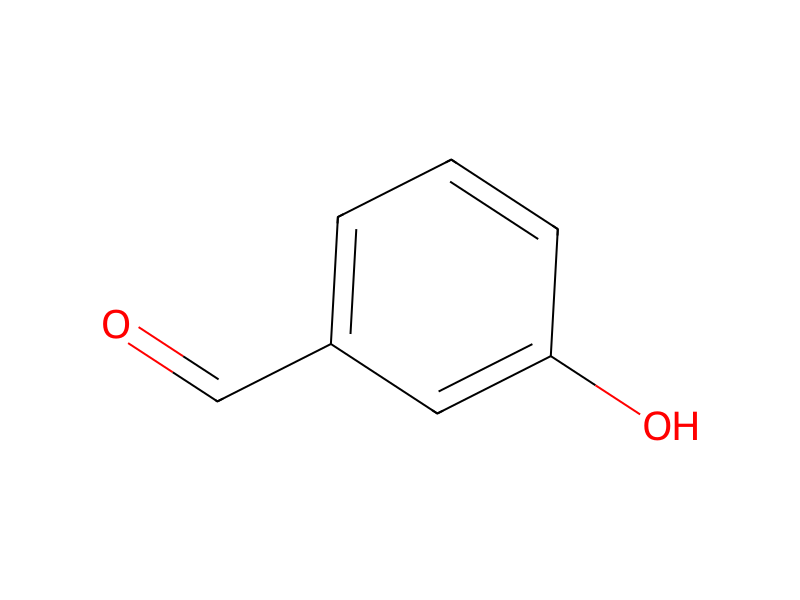
5-Hydroxy-2-nitrobenzaldehyde → 3-Hydroxybenzaldehyde
Reaction equation

OC1C=CC([N+]([O-])=O)=C(C=1)C#N.[OH:13][C:14]1[CH:15]=[CH:16][C:17]([N+]([O-])=O)=[C:18]([CH:21]=1)[CH:19]=[O:20]>>[OH:13][C:14]1[CH:21]=[C:18]([CH:17]=[CH:16][CH:15]=1)[CH:19]=[O:20]Participants
3


Procedure
For example, in Case No. 9 of the above table, the yield of the para nitro isomer (4-nitro isomer), i.e., 5-hydroxy-2-nitrobenzonitrile, is 32.5%, and in Case No. 10 the yield of the para nitro isomer, i.e., 5-hydroxy-2-nitrobenzaldehyde, is 38.47%. Studies have been done in order to separate a single objective nitrated product from such an isomeric mixture. For example, Hornig reported that 5-hydroxy-2-nitrobenzaldehyde in purified form was obtained in 34% yield by recrystallization from water after direct nitration of 3-hydroxybenzaldehyde in benzene. The present inventors followed this procedure, but could not achieve the objective of obtaining the pure product in such a high yield.
Workup
- customto separate a single objective nitrated product from such an isomeric mixture
Sources & evidence
- ORD record
- ord-b22353142a964a0f84e4b0c8655b1c15
- Source dataset
- uspto-grants-1998_12
- Patent number
- US05847231
Reaction notes
Loading…