Phosphorus oxychloride → Ethyl 2-chloro-4-methylpyrimidine-5-carboxylate
Reaction equation

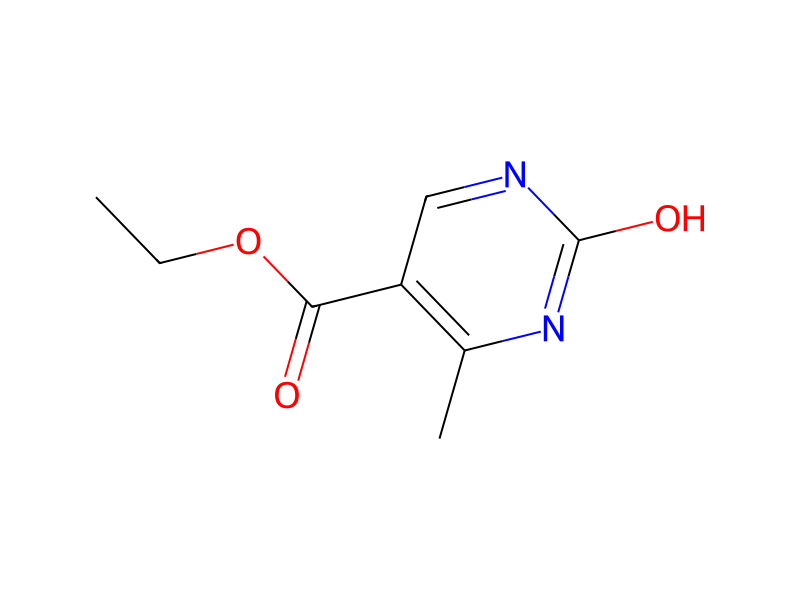
O[C:2]1[N:7]=[C:6]([CH3:8])[C:5]([C:9]([O:11][CH2:12][CH3:13])=[O:10])=[CH:4][N:3]=1.O=P(Cl)(Cl)[Cl:16]>>[Cl:16][C:2]1[N:7]=[C:6]([CH3:8])[C:5]([C:9]([O:11][CH2:12][CH3:13])=[O:10])=[CH:4][N:3]=1Participants
3


Procedure
A solution of ethyl 2-hydroxy-4-methylpyrimidine-5-carboxylate (5 g, 27.5 mmol) and POCl3 (84 g, 550 mmol) was heated at reflux under N2 for 1 h. The reaction was cooled and concentrated. The residue was partitioned between CHCl3 and H2O and the organic layer was dried (Na2SO4), filtered, and concentrated to yield the title compound in a yield of 27% (1.5 g); 1HNMR (CDCl3) δ 9.04 (s, 1H), 4.42 (q, 2H), 2.85 (s, 3H), 1.43 (t, 3H).
Workup
- temperatureat reflux under N2 for 1 h
- temperatureThe reaction was cooled
- concentrationconcentrated
- customThe residue was partitioned between CHCl3 and H2O
- dry with materialthe organic layer was dried (Na2SO4)
- filtrationfiltered
- concentrationconcentrated
Sources & evidence
- ORD record
- ord-986248a5ba764f69baf697b3a073632e
- Source dataset
- uspto-grants-1998_12
- Patent number
- US05852028
Reaction notes
Loading…