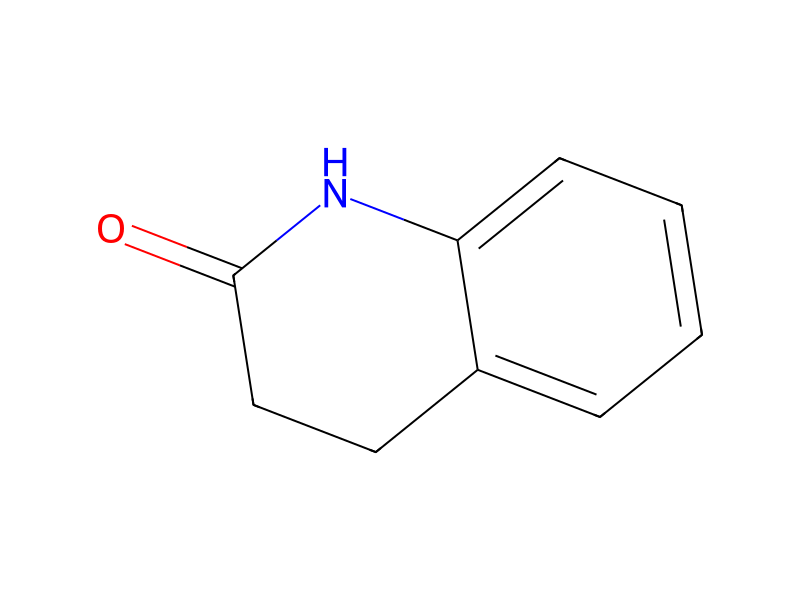
Hydrocarbostyril → 2(1H)-Quinolinone, 6-(2-chloro-1-oxopropyl)-3,4-dihydro-
Reaction equation

[Cl-].[Al+3].[Cl-].[Cl-].[Cl:5][CH:6]([CH3:10])[C:7](Cl)=[O:8].[NH:11]1[C:20]2[C:15](=[CH:16][CH:17]=[CH:18][CH:19]=2)[CH2:14][CH2:13][C:12]1=[O:21]>C(=S)=S>[Cl:5][CH:6]([CH3:10])[C:7]([C:17]1[CH:16]=[C:15]2[C:20](=[CH:19][CH:18]=1)[NH:11][C:12](=[O:21])[CH2:13][CH2:14]2)=[O:8]Participants
5
Reactant 3


Product 1

Reagents, catalysts & solvents 1

Procedure
Aluminum chloride (109 g, 817 mmol) was slurried in carbon disulfide (600 mL) and 2-chloropropionyl chloride (16.8 mL, 173.07 mmol) was added. To this mixture was added 3,4-dihydro-2(1H)-quinolone (20.0 g, 135.89 mmol, J. Amer. Chem. Soc., 1944, 66, 1442). The mixture was refluxed for 4 hours, cooled, and the carbon disulfide poured off and discarded. The reddish residue was carefully quenched with ice water which caused the product to solidify. The solids were collected, rinsed well with water, and suctioned dry followed by drying in vacuo. The product weighed 31.37 g (97%) and had mp 205°-206° C. Analysis calculated for C12H12CINO2 : C, 60.64; H, 5.09; N, 5.89. Found: C, 60.20; H, 4.89; N, 5.78.
Workup
- temperatureThe mixture was refluxed for 4 hours
- temperaturecooled
- customThe reddish residue was carefully quenched with ice water which
- customThe solids were collected
- washrinsed well with water
- customsuctioned dry
- customby drying in vacuo
Sources & evidence
- ORD record
- ord-706508bf7a944230b5efe3e24e0e08a7
- Source dataset
- uspto-grants-1998_12
- Patent number
- US05852040
Reaction notes
Loading…