Hydroxyphenylacetic acid → 4-Hydroxy-3-nitrophenylacetic acid
Reaction equation

[OH:1][C:2]1[CH:7]=[CH:6][C:5]([CH2:8][C:9]([OH:11])=[O:10])=[CH:4][CH:3]=1.[N+:12]([O-])([OH:14])=[O:13].[N+]([O-])(O)=O.C(O)(=O)C>C(O)(=O)C>[N+:12]([C:7]1[CH:6]=[C:5]([CH2:8][C:9]([OH:11])=[O:10])[CH:4]=[CH:3][C:2]=1[OH:1])([O-:14])=[O:13]Participants
Reactant 3
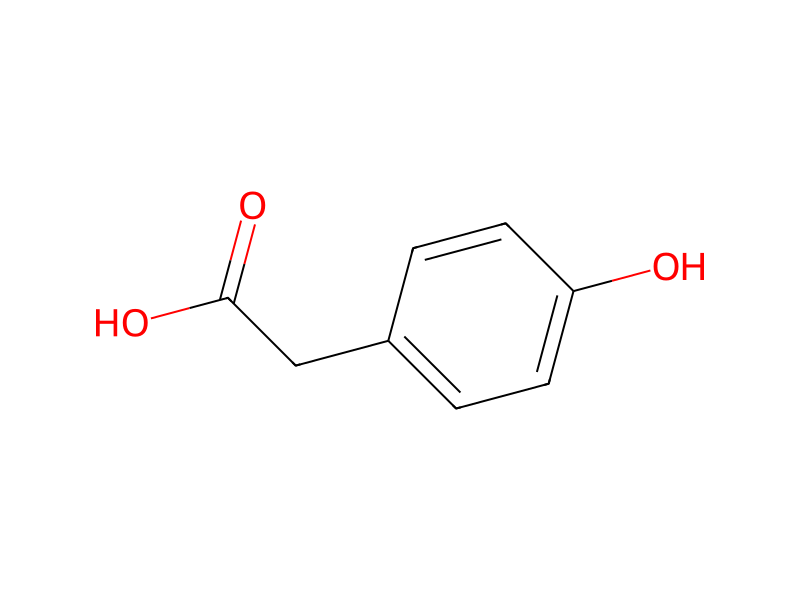


Product 1

Reagents, catalysts & solvents 1

Procedure
In a first step, carried out according to Humel in Synth. Commun. 15, pages 1081-88 (1985), to a magnetically stirred solution of 100 g (0.65,mole) of 4-hydroxyphenyl acetic acid in 250 ml of glacial acetic acid was added dropwise a mixture of 40 ml of nitric acid (1.4 specific gravity) and 60 ml glacial acetic acid. The glacial acetic acid was warmed to about 45° C. to completely dissolve the 4-hydroxyphenyl acetic acid. Following addition of the nitric acid/acetic acid mixture, stirring of the resulting mixture was continued for one hour at 25° C. and then the flask was chilled in ice water for one hour. The resulting crystals were washed with cold water and air-dried at room temperature, the reaction providing 65% of the theoretical yield of 3-nitro 4-hydroxyphenyl acetic acid.
Workup
- washThe resulting crystals were washed with cold water
- customair-dried at room temperature
Sources & evidence
- ORD record
- ord-97bd69b9a7934e52865fda8a893ae0d2
- Source dataset
- uspto-grants-1998_12
- Patent number
- US05852191
Reaction notes
Loading…