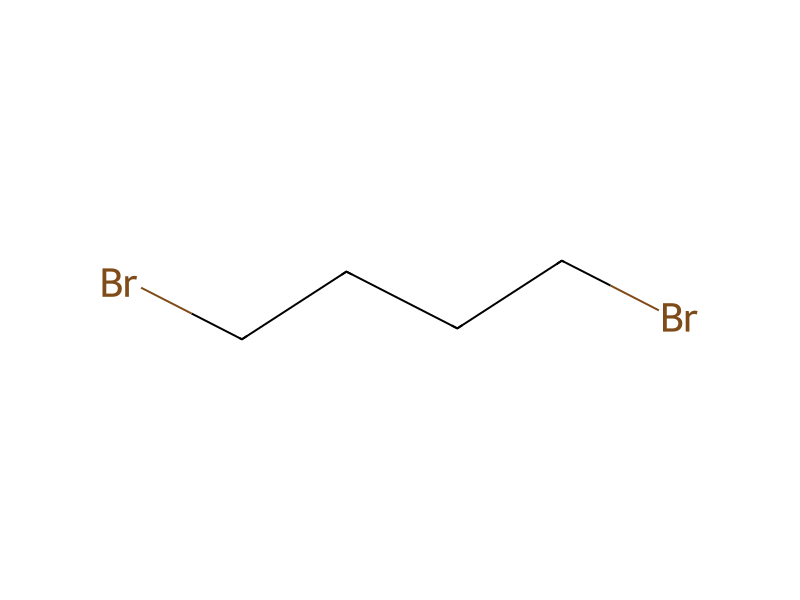
1,4-Dibromobutane → 4-[4-(6-Fluoro-1,2-benzisoxazol-3-yl)-1-piperidinyl]butylbromide
Reaction equation

[F:1][C:2]1[CH:16]=[CH:15][C:5]2[C:6]([CH:9]3[CH2:14][CH2:13][NH:12][CH2:11][CH2:10]3)=[N:7][O:8][C:4]=2[CH:3]=1.C([O-])([O-])=O.[K+].[K+].[Br:23][CH2:24][CH2:25][CH2:26][CH2:27]Br>C(#N)C>[F:1][C:2]1[CH:16]=[CH:15][C:5]2[C:6]([CH:9]3[CH2:10][CH2:11][N:12]([CH2:27][CH2:26][CH2:25][CH2:24][Br:23])[CH2:13][CH2:14]3)=[N:7][O:8][C:4]=2[CH:3]=1Participants
5




Procedure
A mixture of 6-fluoro-3-(4-piperidinyl)-1,2-benzisoxazole (12 g, 55 mmol), K2CO3 (13 g) and 1,4dibromobutane (20 g, 9.3 mmol, 1.7 eq) in acetonitrile (300 ml) was stirred at room temperature overnight. The inorganic material was filtered. The solution was concentrated to ~80 ml, when crystals crashed out. The product was filtered to yield 14.16 g (73%), m.p.=243°-245° C.
Workup
- filtrationThe inorganic material was filtered
- concentrationThe solution was concentrated to ~80 ml, when crystals
- filtrationThe product was filtered
- customto yield 14.16 g (73%), m.p.=243°-245° C.
Sources & evidence
- ORD record
- ord-1839343a6bee46a193be0b86efa6074c
- Source dataset
- uspto-grants-1998_12
- Patent number
- US05854263
Reaction notes
Loading…