Hydrochloric Acid → 2,4-Difluoro-3,5-dichlorophenyl isocyanate
Reaction equation
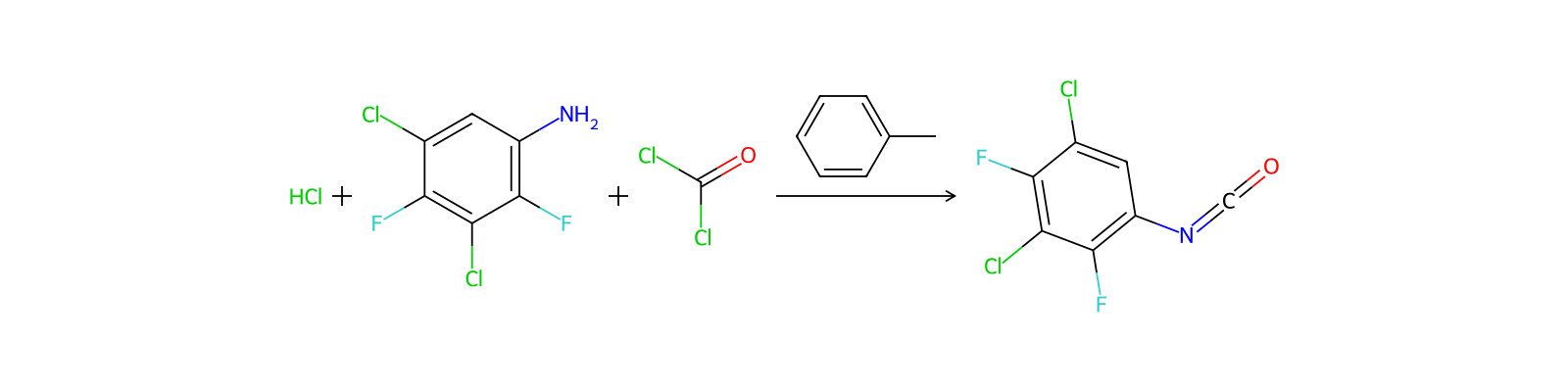
Cl.[F:2][C:3]1[C:9]([Cl:10])=[C:8]([F:11])[C:7]([Cl:12])=[CH:6][C:4]=1[NH2:5].[C:13](Cl)(Cl)=[O:14]>C1(C)C=CC=CC=1>[F:2][C:3]1[C:9]([Cl:10])=[C:8]([F:11])[C:7]([Cl:12])=[CH:6][C:4]=1[N:5]=[C:13]=[O:14]Participants
Reactant 3



Product 1

Reagents, catalysts & solvents 1

Procedure
Hydrogen chloride was passed into a well-stirred solution of 39.6 gm (0.20 mol) of 2,4-difluoro-3,5-dichloroaniline in 400 ml of toluene until a precipitate no longer separated out. The heterogeneous mixture thus obtained was cooled to 5° to 10° C. At this temperature, 40 gm (0.4 mol) of phosgene were passed in, with stirring. The mixture was then heated slowly, with stirring, so that after about two hours a temperature of 100° to 105° C. was reached. Stirring was then continued for seven hours at this temperature. During this time, a clear solution was formed, and hydrogen chloride was liberated. Nitrogen was then passed into the mixture for one hour at the same temperature to drive off the excess phosgene. Thereafter the solvent was distilled off, in vacuo at the end. The crude product which remained was distilled in a water pump vacuum.
Workup
- customno longer separated out
- customThe heterogeneous mixture thus obtained
- temperaturewas cooled to 5° to 10° C
- temperatureThe mixture was then heated slowly
- stirringwith stirring
- stirringStirring
- waitwas then continued for seven hours at this temperature
- customDuring this time, a clear solution was formed
- waitNitrogen was then passed into the mixture for one hour at the same temperature
- distillationThereafter the solvent was distilled off, in vacuo at the end
- distillationThe crude product which remained was distilled in a water pump vacuum
Sources & evidence
- ORD record
- ord-4099fba8036141399119cd1b56dcad0e
- Source dataset
- uspto-grants-1984_07
- Patent number
- US04457943
Reaction notes
Loading…