Oxygen → Disulfide, bis(dipropylthiocarbamoyl)
Reaction equation

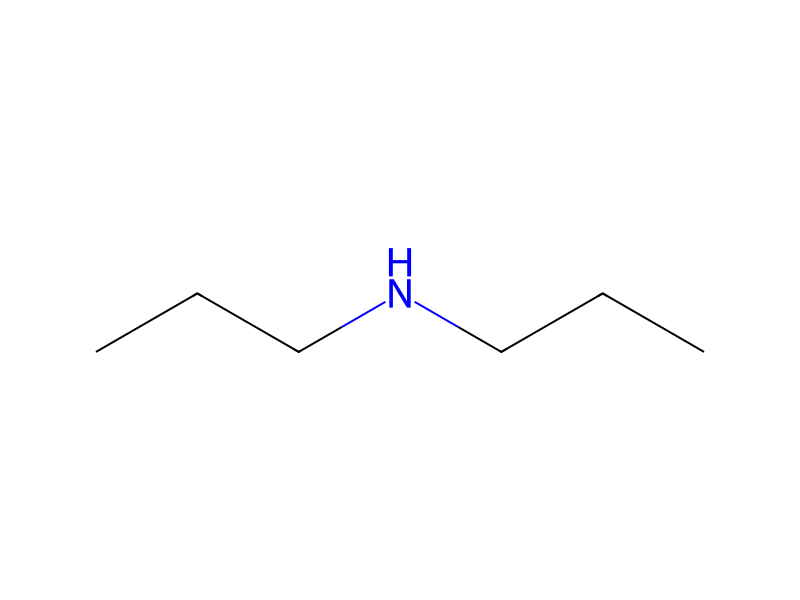
[CH2:1]([NH:4][CH2:5][CH2:6][CH3:7])[CH2:2][CH3:3].[C:8](=[S:10])=[S:9].O=O>C(O)(C)C>[CH2:1]([N:4]([CH2:5][CH2:6][CH3:7])[C:8](=[S:10])[S:9][S:9][C:8](=[S:10])[N:4]([CH2:5][CH2:6][CH3:7])[CH2:1][CH2:2][CH3:3])[CH2:2][CH3:3]Participants
5
Reactant 3


Product 1

Reagents, catalysts & solvents 1

Conditions
- Temperature
- 50 °C
Procedure
20.2 g (0.2 mol) of di-n-propylamine, 24.4 mg (0.1×10⁻³ mol) of Mn(CH3COO)2.4H2O and 100 g of isopropanol were charged to the reaction equipment described in Example 1. 16.0 g (0.21 mol) of carbon disulfide were added thereto, and the resulting solution was heated to 50° C., treated with oxygen at a pressure of 1.7 bar, and stirred vigorously. An immediate absorption of oxygen was observed and the reaction ceased after 75 minutes. 35.1 g of a white, crystalline product were obtained by concentrating and cooling the reaction solution. Upon analysis, the product was found to correspond to tetra-n-propyl thiuram disulfide (yield=99.2% of theoretical, FP=60° C.).
Workup
- customAn immediate absorption of oxygen
- custom35.1 g of a white, crystalline product were obtained
- concentrationby concentrating
- temperaturecooling the reaction solution
Sources & evidence
- ORD record
- ord-8a31a0f4c166420ea0ea9e6a79262fad
- Source dataset
- uspto-grants-1984_07
- Patent number
- US04459424
Reaction notes
Loading…