1,4-Dioxane hydrochloride → HCID 67030367, compound
Reaction equation

C(OC(=O)[NH:7][CH2:8][CH2:9][N:10]([C:13]1[CH:18]=[CH:17][C:16]([Br:19])=[CH:15][CH:14]=1)[CH2:11][CH3:12])(C)(C)C.O1CCOCC1.[ClH:27]>O1CCOCC1>[ClH:27].[ClH:27].[Br:19][C:16]1[CH:15]=[CH:14][C:13]([N:10]([CH2:11][CH3:12])[CH2:9][CH2:8][NH2:7])=[CH:18][CH:17]=1Participants
4
Reactant 2
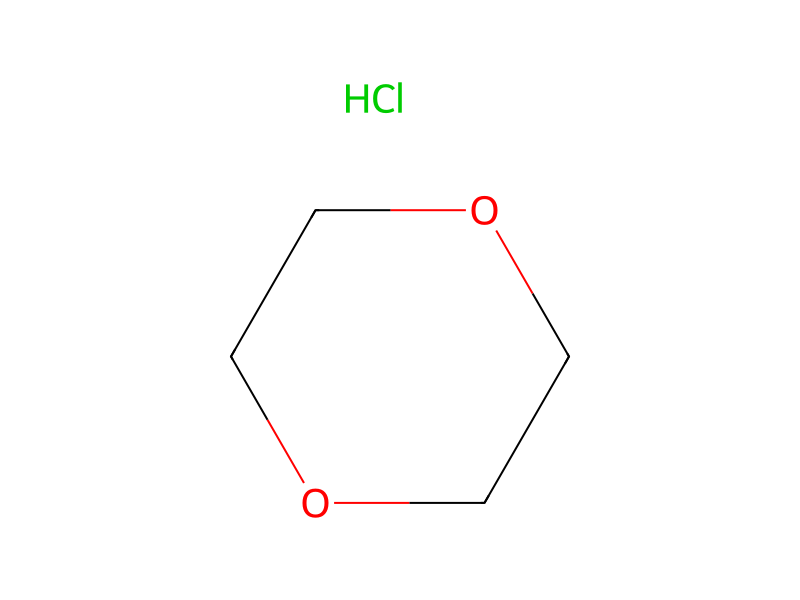

Product 1

Reagents, catalysts & solvents 1

Procedure
tert-Butyl{2-[(4-bromophenyl)(ethyl)amino]ethyl}carbamate (896 mg) synthesized in Production Example 83, step 3 was dissolved in dioxane (5 ml), and 4M-hydrogen chloride dioxane solution (5 ml, 20 mmol) was added dropwise at 0° C. After stirring at room temperature for 2 hrs, the mixture was concentrated under reduced pressure. Dichloromethane was added to the residue, and the mixture was concentrated under reduced pressure, which operation was performed 3 times to remove volatile components such as hydrogen chloride and the like. The residue was dried under reduced pressure to give N-(4-bromophenyl)-N-ethylethane-1,2-diamine dihydrochloride (1.044 g) as a yellow gum-like solid.
Workup
- concentrationthe mixture was concentrated under reduced pressure
- additionDichloromethane was added to the residue
- concentrationthe mixture was concentrated under reduced pressure, which operation
- customto remove volatile components such as hydrogen chloride
- customThe residue was dried under reduced pressure
Sources & evidence
- ORD record
- ord-283140415ee440e28d90c82612e80d2f
- Source dataset
- uspto-grants-2015_04
- Patent number
- US08999989B2
Reaction notes
Loading…