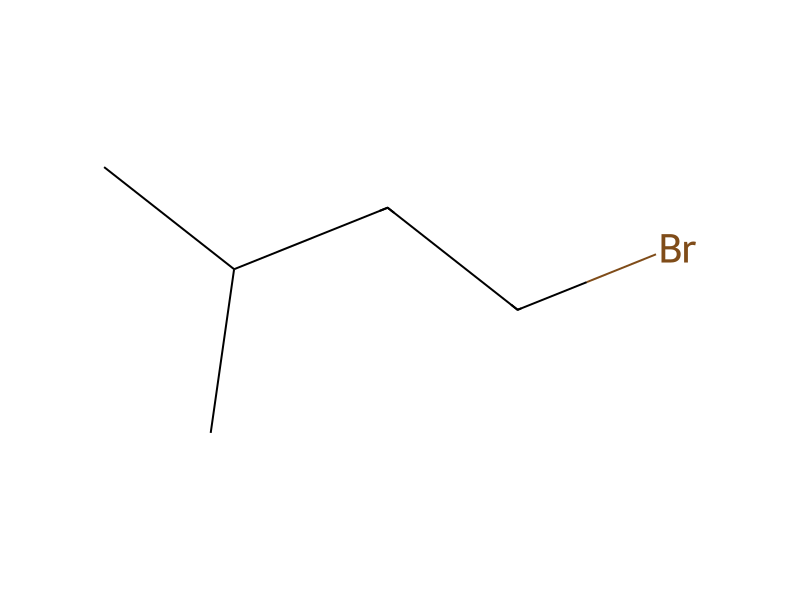
1-Bromo-3-methylbutane → HCID 66847207, compound
Reaction equation

[N+:1]([C:4]1[CH:5]=[N:6][NH:7][CH:8]=1)([O-:3])=[O:2].Br[CH2:10][CH2:11][CH:12]([CH3:14])[CH3:13].C(=O)([O-])[O-].[Cs+].[Cs+]>COCCOC.C(OCC)(=O)C>[CH2:10]([N:6]1[CH:5]=[C:4]([N+:1]([O-:3])=[O:2])[CH:8]=[N:7]1)[CH2:11][CH:12]([CH3:14])[CH3:13]Participants
Reactant 3


Product 1

Reagents, catalysts & solvents 2


Conditions
- Temperature
- 55 °C
Procedure
A mixture of 4-Nitro-1H-pyrazole (234 mg, 2.06 mmol, 1.0 eq), 1-Bromo-3-methylbutane (0.30 ml, 2.48 mmol, 1.2 eq), and Cesium carbonate (1.01 g, 3.10 mmol, 1.5 eq) in 5.0 mL 1,2-Dimethoxyethane was stirred at 55° C. for 12 hours. The reaction mixture was cooled to room temperature and diluted with 25 mL ethyl acetate and filtered. The filtrate was then concentrated and the residue was dissolved in 5 mL dichloromethane and purified by flash column chromatography (silica, 0-80% ethyl acetate in heptane in 30 minutes) to yield 357.6 mg (94.32%) of Isopentyl-4-nitro-1H-pyrazole as a white solid. LCMS (ESI) m+H=184.1 1H NMR (400 MHz, CDCl3) δ 8.11 (s, 1H), 8.06 (s, 1H), 4.20-4.14 (m, 2H), 1.80 (dd, J=14.8, 7.1, 2H), 1.60 (dp, J=13.4, 6.7, 1H), 0.97 (d, J=6.6, 6H).
Workup
- temperatureThe reaction mixture was cooled to room temperature
- filtrationfiltered
- concentrationThe filtrate was then concentrated
- dissolutionthe residue was dissolved in 5 mL dichloromethane
- custompurified by flash column chromatography (silica, 0-80% ethyl acetate in heptane in 30 minutes)
Sources & evidence
- ORD record
- ord-988102e95e4a40bab7244e1fff4cf51b
- Source dataset
- uspto-grants-2015_04
- Patent number
- US08999998B2
Reaction notes
Loading…