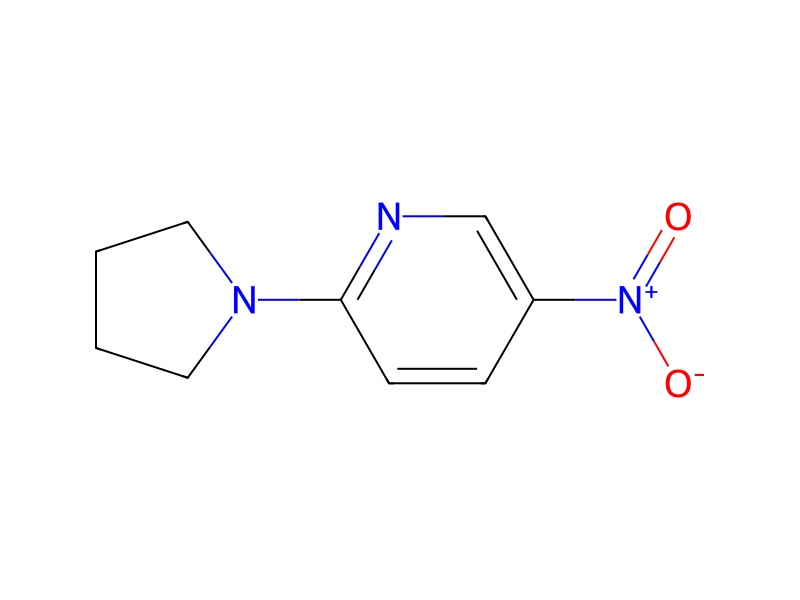
Pyrrolidine → 5-Nitro-2-(1-pyrrolidinyl)pyridine
Reaction equation

Cl[C:2]1[CH:7]=[CH:6][C:5]([N+:8]([O-:10])=[O:9])=[CH:4][N:3]=1.[NH:11]1[CH2:15][CH2:14][CH2:13][CH2:12]1>CCO>[N+:8]([C:5]1[CH:6]=[CH:7][C:2]([N:11]2[CH2:15][CH2:14][CH2:13][CH2:12]2)=[N:3][CH:4]=1)([O-:10])=[O:9]Participants
4
Reactant 2


Product 1
Reagents, catalysts & solvents 1

Conditions
- Temperature
- 70 °C
Procedure
To a slurry of 2-chloro-5-nitropyridine (10 g, 63.1 mmol) in EtOH (100 mL) at room temperature was added pyrrolidine (15.72 mL, 189 mmol) and the mixture was heated at 70° C. for 18 h. The cooled solution was concentrated in vacuo and the residue partitioned between CH2Cl2 and 1M NaOH. The organic layer was dried (Na2SO4), filtered and solvent removed in vacuo to give title compound (9.52 g, 78%). MS (ESI) m/z 194 (M+H)+.
Workup
- concentrationThe cooled solution was concentrated in vacuo
- customthe residue partitioned between CH2Cl2 and 1M NaOH
- dry with materialThe organic layer was dried (Na2SO4)
- filtrationfiltered
- customsolvent removed in vacuo
Sources & evidence
- ORD record
- ord-d741051153424e11b8b3c3fc5313d949
- Source dataset
- uspto-grants-2015_04
- Patent number
- US09006387B2
Reaction notes
Loading…