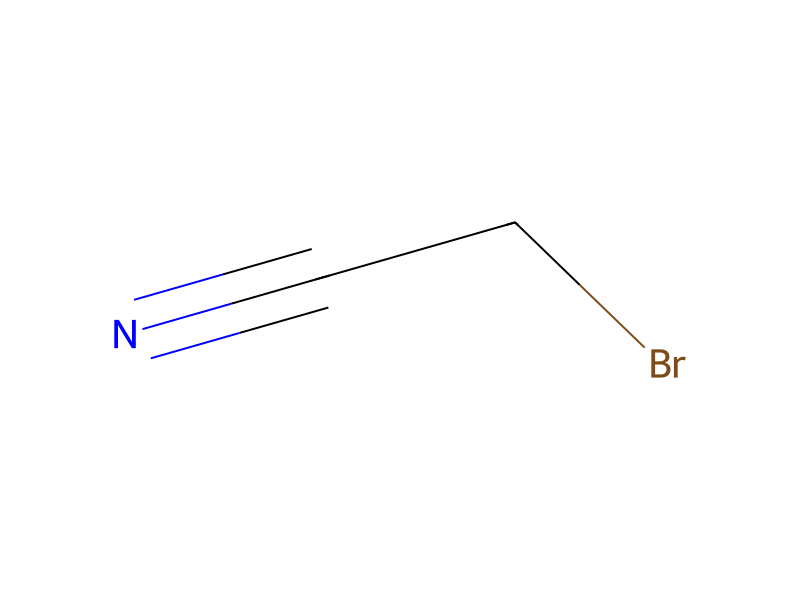
Bromoacetonitrile → HCID 86658359, compound
Reaction equation

[NH2:1][C:2]1([CH2:18][OH:19])[C:15]2[CH:14]=[C:13]([Cl:16])[N:12]=[CH:11][C:10]=2[O:9][C:8]2[C:3]1=[CH:4][C:5]([Br:17])=[CH:6][CH:7]=2.Br[CH2:21][C:22]#[N:23].[OH-].[Na+]>S([O-])(O)(=O)=O.C([N+](CCCC)(CCCC)CCCC)CCC.C1COCC1>[NH2:1][C:2]1([CH2:18][O:19][CH2:21][C:22]#[N:23])[C:15]2[CH:14]=[C:13]([Cl:16])[N:12]=[CH:11][C:10]=2[O:9][C:8]2[C:3]1=[CH:4][C:5]([Br:17])=[CH:6][CH:7]=2Participants




Procedure
A 500-mL RBF was charged with 7-bromo-3-chloro-5H-chromeno[2,3-c]pyridin-5-one (12.3789 g, 39.9 mmol), trimethylsulfonium iodide (8.95 g, 43.9 mmol), and DMSO (199 mL). The resulting slurry was stirred vigorously for 5 minutes leading to a tan slurry before potassium 2-methylpropan-2-olate (4.92 g, 43.9 mmol) was added in one portion. The resulting reddish orange solution was maintained at rt for 2 hours at which time azidotrimethylsilane (10.49 mL, 80 mmol) was added in one portion. The heterogeneous mixture became homogeneous after 2-3 hours. The solution was maintained at RT overnight before being diluted with EtOAc and transferred to a separatory funnel containing saturated NaHCO3 (500 mL). The layers were separated and the aqueous layer was extracted with EtOAc (3×250 mL). The combined organic layers were sequentially washed with water and brine and dried over sodium sulfate. The solution was concentrated in vacuo to provide an orange oil that was evaporated from DCM (3×250 mL) to provide 5-azido-7-bromo-3-chloro-5-((trimethylsilyloxy)methyl)-5H-chromeno[2,3-c]pyridine which was carried on without further purification. A solution of the derived foam in THF (250 mL) was cooled to 0° C. and LAH (2M in THF) (39.9 mL, 80 mmol) was. The reaction was maintained at 0° C. for 2 hours then allowed to warm to RT for 30 minutes. The reaction was diluted with 150 mL of THF and quenched by the addition of sodium sulfate decahydrate (38.5 g, 120 mmol). After the addition was complete the slurry was stirred at RT for 1.5 hours before being filtered through a pad of celite. The filter pad was washed with THF. The filtrate was concentrated under vacuum to give a brown foam. The foam was concentrated from DCM twise and left under vacuum overnight. The solid was taken up in DCM (75 mL) and heated to boiling for 1 minute. The mixture was cooled to RT, and then placed in the fridge for 1 hour. The solid was filtered, washed with DCM (50 mL) and dried to provide (5-amino-7-bromo-3-chloro-5H-chromeno[2,3-c]pyridin-5-yl)methanol (8.94 g) as a light orange solid. Step 2: A 4-neck 3000-mL RBF with a mechanical stirrer was charged with (5-amino-7-bromo-3-chloro-5H-chromeno[2,3-c]pyridin-5-yl)methanol (29.43 g, 86 mmol), tetrabutylammonium hydrogen sulfate (5.85 g, 17.23 mmol), THF (431 mL), and bromoacetonitrile (30.0 mL, 431 mmol) to give a clear, brown solution. The resulting solution was stirred vigorously for 5 min, then a 2N aq. solution of NaOH (431 mL, 862 mmol) was added in one portion. The mixture was stirred overnight and concentrated under vacuum. The remaining material was partitioned between EtOAc (500 mL) and water (500 mL). The layers were separated and the aqueous layer was extracted with EtOAc (2×250 mL). The combined organic layers were washed with brine and dried over magnesium sulfate. The solvent was removed under reduced pressure. The residue was taken up in DCM and filtered through a short pad of silica gel. The filtrate was concentrated and purified by silica gel chromatography (0.5% MeOH/DCM) to provide 2-((5-amino-7-bromo-3-chloro-5H-chromeno[2,3-c]pyridin-5-yl)methoxy)acetonitrile. Step 3: A flask was charged with 2-((5-amino-7-bromo-3-chloro-5H-chromeno[2,3-c]pyridin-5-yl)methoxy)acetonitrile (21 g, 55.2 mmol), dioxane (460 mL) and HCl (4M in dioxane) (55.2 mL, 221 mmol) under nitrogen atmosphere. The reaction mixture was heated to 100° C. overnight. The mixture was cooled to RT and filtered. The filter cake was washed sequentially with dioxane and ether. The collected material was dried to give 15.72 g of a cream-colored solid, which was dissolved in DCM (100 mL) and saturated aqueous sodium bicarbonate (750 mL). The mixture was extracted with DCM (2×250 mL) and EtOAc (2×250 mL). The combined organic extracts were dried over sodium sulfate and concentrated to give 7-bromo-3-chloro-2′,6′-dihydrospiro[chromeno[2,3-c]pyridine-5,3′-[1,4]oxazin]-5′-amine (Intermediate 1, 14.63 g) as an off-white solid. Step 4: 7-Bromo-3-chloro-2′,6′-dihydrospiro[chromeno[2,3-c]pyridine-5,3′-[1,4]oxazin]-5′-amine was chromatographed using supercritical CO2 (additives 25% MeOH with 0.2% DEA) on a Chiralpak AD-H column (50×150 mm, 5 μm) eluting at a flow rate 300 ml/min (100 bar pressure, 40° C. column temperature). The first peak (retention time=1.6 min) provided (R)-7-bromo-3-chloro-2′,6′-dihydrospiro[chromeno[2,3-c]pyridine-5,3′-[1,4]oxazin]-5′-amine (example 9B; intermediate 10A; >99% ee), and the second peak (retention time=2.4 min) provided (S)-7-bromo-3-chloro-2′,6′-dihydrospiro[chromeno[2,3-c]pyridine-5,3′-[1,4]oxazin]-5′-amine (example 9A; intermediate 10B; >99% ee).
Workup
- customto give a clear, brown solution
- stirringThe mixture was stirred overnight
- concentrationconcentrated under vacuum
- customThe remaining material was partitioned between EtOAc (500 mL) and water (500 mL)
- customThe layers were separated
- extractionthe aqueous layer was extracted with EtOAc (2×250 mL)
- washThe combined organic layers were washed with brine
- dry with materialdried over magnesium sulfate
- customThe solvent was removed under reduced pressure
- filtrationfiltered through a short pad of silica gel
- concentrationThe filtrate was concentrated
- custompurified by silica gel chromatography (0.5% MeOH/DCM)
Sources & evidence
- ORD record
- ord-391f93c9775c4fbcb2e620f032699778
- Source dataset
- uspto-grants-2015_04
- Patent number
- US09012446B2
Reaction notes
Loading…