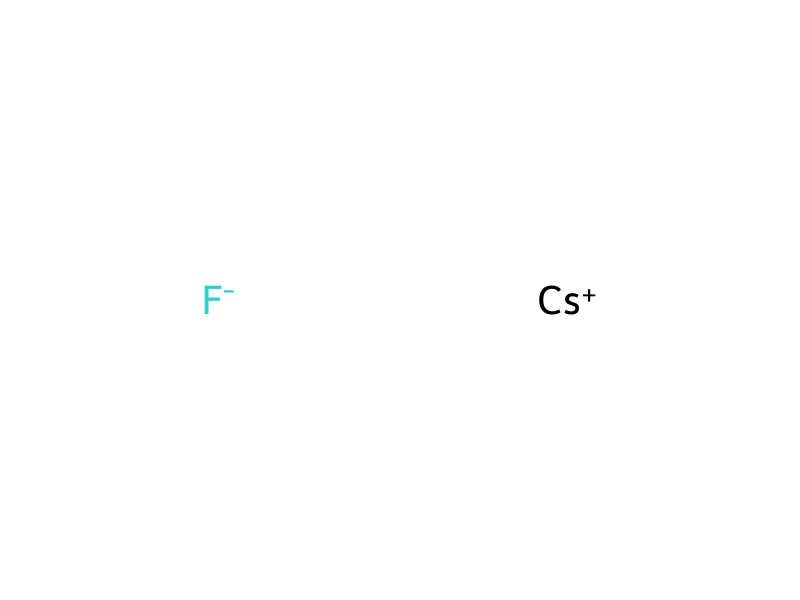
Cesium fluoride → 4-(4-Fluoro-6-methoxyquinolin-2-yl)benzonitrile
Reaction equation

Cl[C:2]1[C:11]2[C:6](=[CH:7][CH:8]=[C:9]([O:12][CH3:13])[CH:10]=2)[N:5]=[C:4]([C:14]2[CH:21]=[CH:20][C:17]([C:18]#[N:19])=[CH:16][CH:15]=2)[CH:3]=1.[F-:22].[Cs+]>[N+](CCCC)(CCCC)(CCCC)CCCC.[Br-].CS(C)=O>[F:22][C:2]1[C:11]2[C:6](=[CH:7][CH:8]=[C:9]([O:12][CH3:13])[CH:10]=2)[N:5]=[C:4]([C:14]2[CH:21]=[CH:20][C:17]([C:18]#[N:19])=[CH:16][CH:15]=2)[CH:3]=1Participants
5




Conditions
- Temperature
- 150 °C
Procedure
A mixture of 4-(4-chloro-6-methoxyquinolin-2-yl)benzonitrile (See Example 11, step 1) (1 g, 3.4 mmol), CsF (5.2 g, 34 mmol), and n-Bu4NBr (109 mg, 0.34 mmol) in DMSO (10 mL) was heated to 150° C. for 2 h. An aqueous/EtOAC workup was followed by purification by column chromatography (PE/EA=10/1) to afford desired product (300 mg, 31.7%).
Workup
- customAn aqueous/EtOAC workup was followed by purification by column chromatography (PE/EA=10/1)
Sources & evidence
- ORD record
- ord-598c4aeabe62427cbf5c82ee70df24bb
- Source dataset
- uspto-grants-2015_04
- Patent number
- US09012646B2
Reaction notes
Loading…