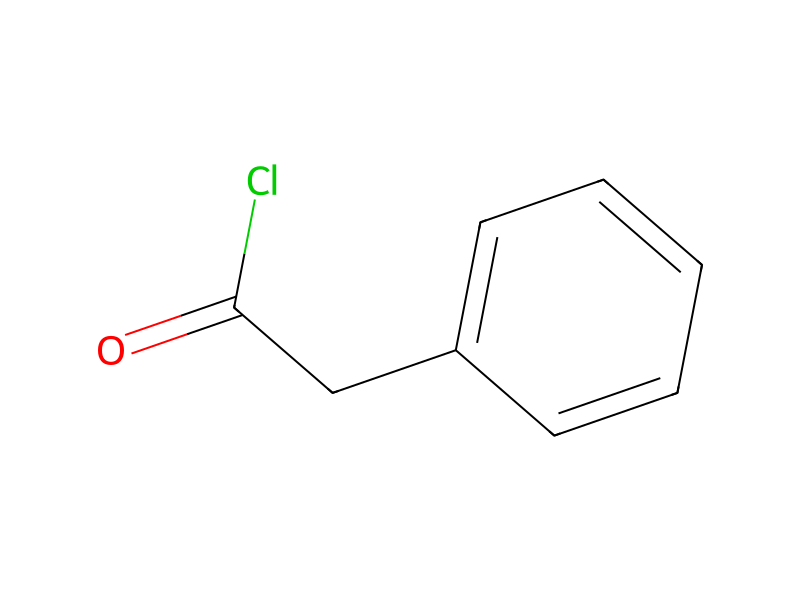
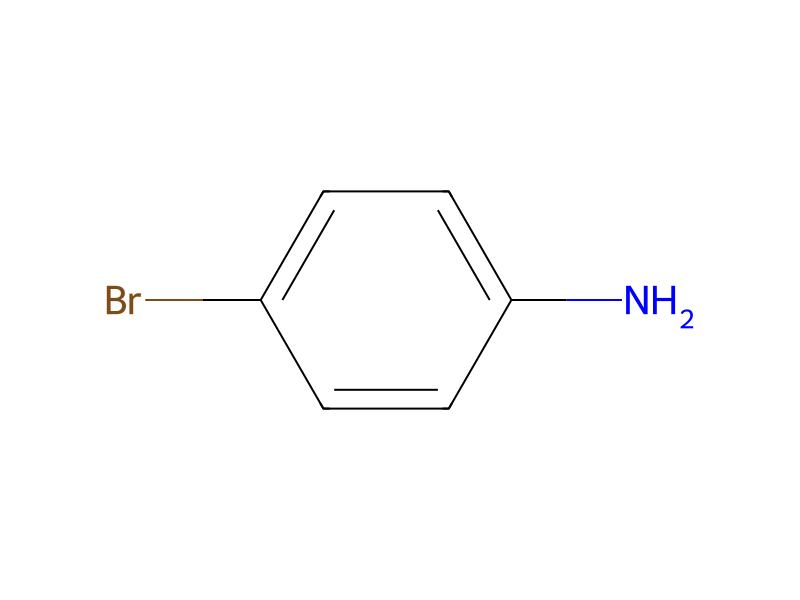
Phenylacetyl chloride → N-(4-bromophenyl)-2-phenylacetamide
Reaction equation

[Br:1][C:2]1[CH:8]=[CH:7][C:5]([NH2:6])=[CH:4][CH:3]=1.C(N(CC)CC)C.[C:16]1([CH2:22][C:23](Cl)=[O:24])[CH:21]=[CH:20][CH:19]=[CH:18][CH:17]=1>ClCCl>[Br:1][C:2]1[CH:8]=[CH:7][C:5]([NH:6][C:23](=[O:24])[CH2:22][C:16]2[CH:21]=[CH:20][CH:19]=[CH:18][CH:17]=2)=[CH:4][CH:3]=1Participants
5
Reactant 3

Product 1

Reagents, catalysts & solvents 1

Procedure
Into a 250-mL round-bottom flask were placed a solution of 4-bromoaniline (17.1 g, 99.42 mmol) and triethylamine (30 g, 297 mmol) in dichloromethane (100 mL). Then, 2-phenylacetyl chloride (18.6 g, 120 mmol) was added dropwise with stirring, and the resulting solution was stirred at room temperature for 6 hours. The solids were filtered out, and the filtrate was concentrated under vacuum. The crude product was purified by re-crystallization from ethyl acetate to provide the title compound as a white solid.
Workup
- customInto a 250-mL round-bottom flask were placed
- stirringthe resulting solution was stirred at room temperature for 6 hours
- filtrationThe solids were filtered out
- concentrationthe filtrate was concentrated under vacuum
- customThe crude product was purified by re-crystallization from ethyl acetate
Sources & evidence
- ORD record
- ord-d4e6715f3ff842009951e30083b9a0e8
- Source dataset
- uspto-grants-2016_08
- Patent number
- US09403816B2
Reaction notes
Loading…