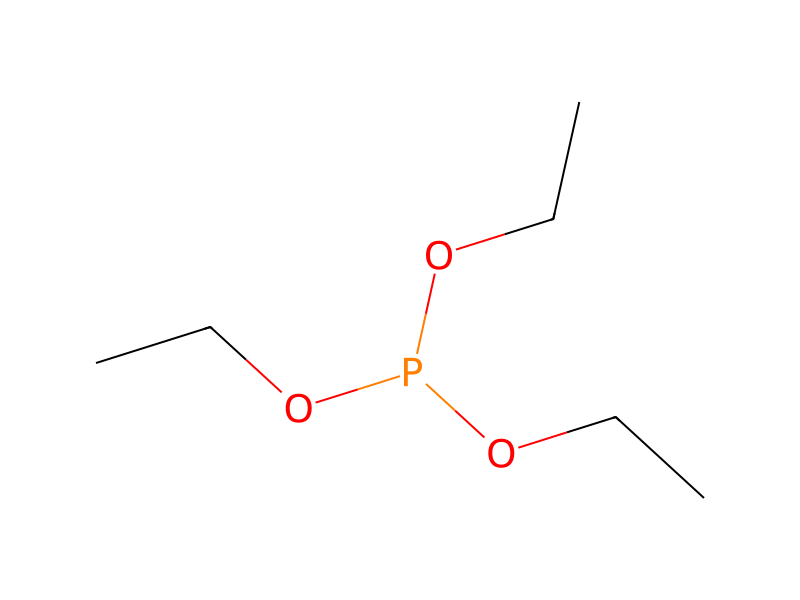
Triethyl phosphite → HCID 117599383, compound
Reaction equation

[Cl:1][CH2:2][C:3]1[CH:4]=[CH:5][C:6]([OH:11])=[C:7]([CH:10]=1)[CH:8]=[O:9].[CH2:12]([O:14][P:15]([O:19][CH2:20][CH3:21])[O:16][CH2:17][CH3:18])[CH3:13]>C(OCC)(=O)C>[Cl-:1].[CH2:12]([O:14][P+:15]([O:19][CH2:20][CH3:21])([O:16][CH2:17][CH3:18])[CH2:2][C:3]1[CH:4]=[CH:5][C:6]([OH:11])=[C:7]([CH:8]=[O:9])[CH:10]=1)[CH3:13]Participants
Reactant 2

Product 1

Reagents, catalysts & solvents 1

Conditions
- Temperature
- 80 °C
Procedure
A 100-mL round-bottom flask was charged with 5-chloromethyl-2-hydroxybenzaldehyde (10.3327 g, 60.4 mmol) and dissolved in ethyl acetate (40 mL) and triethylphosphite (11.5 mL, 67 mmol) was added. The mixture was heated at reflux (80° C.) for 3 hours. The mixture was cooled to room temperature and the solvent removed under reduced pressure to give triethoxy(3-formyl-4-hydroxybenzyl)phosphonium chloride as a viscous oil which was used without further purification. The viscous oil (10.003 g, 30 mmol) was dissolved in ethanol (40 mL) and ethylenediamine (1.2 mL, 18 mmol) was added slowly. The mixture was heated at reflux (80° C.) for 3 hours. The mixture was cooled to room temperature and the solvent was removed under reduced pressure to give a thick, yellow, oily substance. The oil was washed with ether (3×10 mL). The ether was evaporated slowly over 24 hours to produce a thick, yellow, viscous oil (10.2215 g, 98%) in ˜85% purity based on 1H NMR spectroscopy.
Workup
- temperatureThe mixture was heated
- temperatureThe mixture was cooled to room temperature
- customthe solvent removed under reduced pressure
Sources & evidence
- ORD record
- ord-735e3775c1e9458c8eb0f28823ae8ce2
- Source dataset
- uspto-grants-2016_08
- Patent number
- US09409125B2
Reaction notes
Loading…