Water → 2-(4-(Trifluoromethyl)phenyl)isonicotinonitrile
Reaction equation

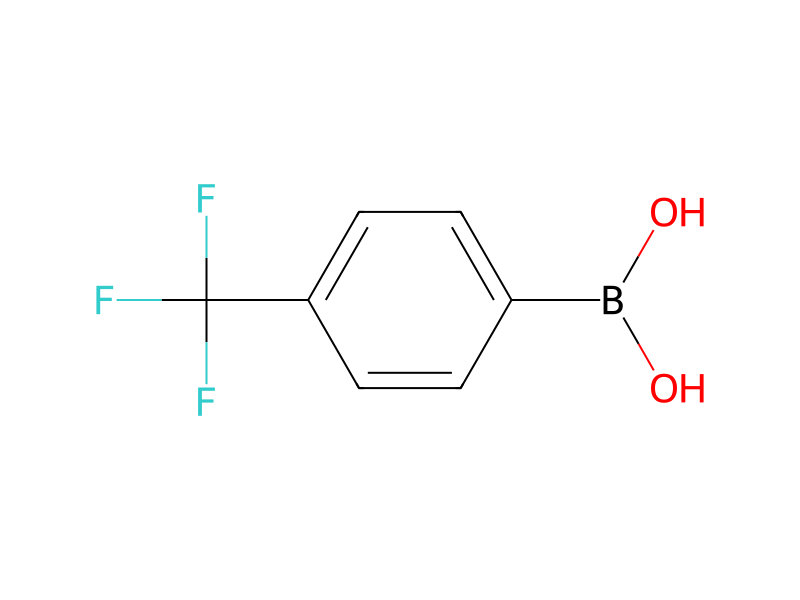
Cl[C:2]1[CH:7]=[C:6]([C:8]#[N:9])[CH:5]=[CH:4][N:3]=1.O.C(=O)(O)[O-].[Na+].[F:16][C:17]([F:28])([F:27])[C:18]1[CH:23]=[CH:22][C:21](B(O)O)=[CH:20][CH:19]=1>C(COC)OC>[F:16][C:17]([F:28])([F:27])[C:18]1[CH:23]=[CH:22][C:21]([C:2]2[CH:7]=[C:6]([C:8]#[N:9])[CH:5]=[CH:4][N:3]=2)=[CH:20][CH:19]=1Participants





Procedure
2-Chloropyridine-4-carbonitrile 19 (2.96 g, 21.35 mmol) was dissolved in 100 ml of dimethoxyethane. The solution was added with 70 ml of water, sodium bicarbonate (3 equiv., 5.38 g), [4-(trifluoromethyl)phenyl]boronic acid (1.2 equiv., 4.87 g) and the mixture was then stirred at rt for 5′. The mixture was degassed and placed under argon. A catalytic amount of tetrakispalladium was added and the mixture heated at 100° C. overnight. The solvents were evaporated off and the resulting residue dissolved with ethyl acetate and then washed with water and brine. The organic phase was dried over sodium sulfate and concentrated under vacuum. The crude was crystallized from ethyl acetate and petroleum ether to give a beige solid. (2.5 g, 47% yield).
Workup
- customThe mixture was degassed
- additionA catalytic amount of tetrakispalladium was added
- temperaturethe mixture heated at 100° C. overnight
- customThe solvents were evaporated off
- dissolutionthe resulting residue dissolved with ethyl acetate
- washwashed with water and brine
- dry with materialThe organic phase was dried over sodium sulfate
- concentrationconcentrated under vacuum
- customThe crude was crystallized from ethyl acetate and petroleum ether
- customto give a beige solid
Sources & evidence
- ORD record
- ord-7314503ba45f4ebd92f8ab57aab93ecc
- Source dataset
- uspto-grants-2016_08
- Patent number
- US09409864B2
Reaction notes
Loading…