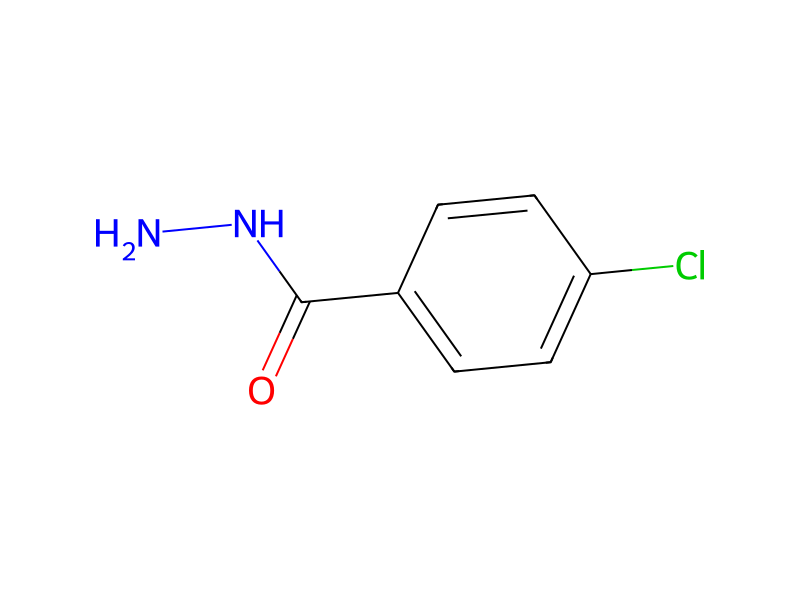
4-Chlorobenzohydrazide → HCID 790251, compound
Reaction equation

[Cl:1][C:2]1[CH:11]=[CH:10][C:5]([C:6]([NH:8][NH2:9])=[O:7])=[CH:4][CH:3]=1.[S:12]1[CH:16]=[CH:15][CH:14]=[C:13]1[C:17](Cl)=O.O=P(Cl)(Cl)Cl>C(Cl)(Cl)Cl>[Cl:1][C:2]1[CH:11]=[CH:10][C:5]([C:6]2[O:7][C:17]([C:13]3[S:12][CH:16]=[CH:15][CH:14]=3)=[N:9][N:8]=2)=[CH:4][CH:3]=1Participants
Reactant 3


Product 1

Reagents, catalysts & solvents 1

Procedure
To 250 mL round bottom flask was added 2.0 g (11.7 mmol, 1 eq) of 4-chlorobenzhydrazide (1) in 100 mL of amelene stabilized chloroform, followed by addition of 4 mL (29.25 mmol, 2.5 eq) of TEA. Then, 1.4 mL (12.87 mmol, 1.1 eq) of 2-thiophenecarbonyl chloride (2) was added drop-wise and the mixture was stirred at ambient temperature for 1 h. Reaction progress was monitored by LCMS on a twelve minute gradient. The formed white precipitate was filtered, washed with chloroform and then dried on the high vacuum for two hours. The resulting material was confirmed to be the desired diacylhydrazide and was used in the next step without further purification. The crude diacyl-hydrazide was dissolved in 60 mL of POCl3 under heating. The resulting mixture was then heated under reflux in oil bath (100-110° C.) for 5-7 h. The reaction progress was monitored by LCMS on a twelve minute gradient. Once the cyclization reaction was completed as determined by LCMS, POCl3 was carefully evaporated in vacuum and the reaction was then neutralized with a 1 N solution of ammonium hydroxide. The product was extracted with ethyl acetate (300 mL) from saturated solution of NaHCO3 (200 mL), washed with a brine (2×200 mL), then dried over sodium sulfate, filtered and evaporated to dryness. The product was purified by flash column chromatography (hexane→>12% ethyl acetate/hexane), and then recrystallized from mixture of hexane/ethyl acetate (5:1) to give 1.3 g of the desired compound 2-(4-Chloro-phenyl)-5-thiophen-2-yl[1,3,4]oxadiazole (42%) as a white solid.
Workup
- customReaction progress
- waitwas monitored by LCMS on a twelve minute
- filtrationThe formed white precipitate was filtered
- washwashed with chloroform
- customdried on the high vacuum for two hours
- customwas used in the next step without further purification
- dissolutionThe crude diacyl-hydrazide was dissolved in 60 mL of POCl3
- temperatureunder heating
- temperatureThe resulting mixture was then heated
- temperatureunder reflux in oil bath (100-110° C.) for 5-7 h
- waitThe reaction progress was monitored by LCMS on a twelve minute
- customOnce the cyclization reaction
- customwas carefully evaporated in vacuum
- extractionThe product was extracted with ethyl acetate (300 mL) from saturated solution of NaHCO3 (200 mL)
- washwashed with a brine (2×200 mL)
- dry with materialdried over sodium sulfate
- filtrationfiltered
- customevaporated to dryness
- customThe product was purified by flash column chromatography (hexane→>12% ethyl acetate/hexane)
- customrecrystallized from mixture of hexane/ethyl acetate (5:1)
Sources & evidence
- ORD record
- ord-97e6334d17bf479b9a7875a1580310fb
- Source dataset
- uspto-grants-2016_08
- Patent number
- US09420788B2
Reaction notes
Loading…