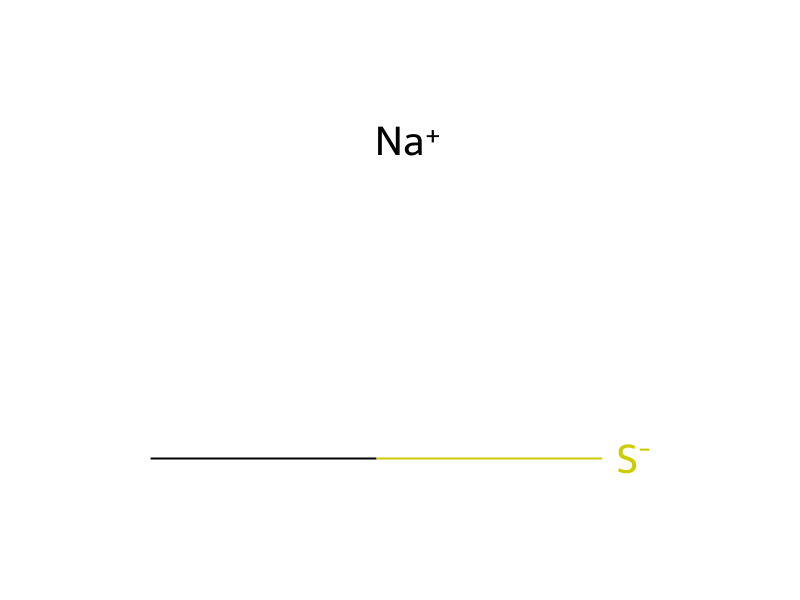
Sodium methanethiolate → (R)-4-(2-chloro-6-(methylthiomethyl)pyrimidin-4-yl)-3-methylmorpholine
Reaction equation

[Cl:1][C:2]1[N:7]=[C:6]([N:8]2[CH2:13][CH2:12][O:11][CH2:10][C@H:9]2[CH3:14])[CH:5]=[C:4]([CH2:15]I)[N:3]=1.[CH3:17][S-:18].[Na+]>CN(C=O)C>[Cl:1][C:2]1[N:7]=[C:6]([N:8]2[CH2:13][CH2:12][O:11][CH2:10][C@H:9]2[CH3:14])[CH:5]=[C:4]([CH2:15][S:18][CH3:17])[N:3]=1Participants



Conditions
- Temperature
- 25 °C
Procedure
Lithium iodide (17.57 g, 131.27 mmol) was added to (R)-(2-chloro-6-(3-methylmorpholino)pyrimidin-4-yl)methyl methanesulfonate (19.2 g, 59.67 mmol) in dioxane (300 ml) and heated to 100° C. for 2 hours under nitrogen. The reaction mixture was quenched with water (200 ml) and extracted with EtOAc (3×200 ml). The organic layers were combined and washed with 2M sodium bisulfite solution (400 ml), water (400 ml), brine (400 ml) dried over MgSO4 and then evaporated. The residue was triturated with Et2O to afford (R)-4-(2-chloro-6-(iodomethyl)pyrimidin-4-yl)-3-methylmorpholine (13.89 g, 66%); 1H NMR (400 MHz, CDCl3) 1.32 (3H, d), 3.28 (1H, td), 3.54 (1H, td), 3.69 (1H, dd), 3.78 (1H, d), 3.98-4.02 (2H, m), 4.21 (2H, s), 4.29 (1H, br s), 6.41 (1H, s); m/z: (ESI+) MH+ 354.31. The mother liquors were concentrated down and triturated with Et2O to afford a further crop of (R)-4-(2-chloro-6-(iodomethyl)pyrimidin-4-yl)-3-methylmorpholine (2.46 g, 12%); 1H NMR (400 MHz, CDCl3) 1.32 (3H, d), 3.28 (1H, td), 3.54 (1H, td), 3.69 (1H, dd), 3.78 (1H, d), 3.98-4.02 (2H, m), 4.21 (2H, s), 4.30 (1H, s), 6.41 (1H, s); m/z: (ESI+) MH+, 354.31. Alternatively, this step can be carried out as follows: (R)-(2-Chloro-6-(3-methylmorpholino)pyrimidin-4-yl)methyl methanesulfonate (80 g, 248.62 mmol) and lithium iodide (83 g, 621.54 mmol) were dissolved in dioxane (300 ml) and then heated at 107° C. for 1 hour. The reaction mixture was quenched with water (250 ml), extracted with EtOAc (3×250 ml), the organic layer was dried over MgSO4, filtered and evaporated. The residue was dissolved in DCM and Et2O was added, the mixture was passed through silica (4 inches) and eluted with Et2O. Fractions containing product were evaporated and the residue was then triturated with Et2O to give a solid which was collected by filtration and dried under vacuum to afford (R)-4-(2-chloro-6-(iodomethyl)pyrimidin-4-yl)-3-methylmorpholine (75 g, 86%); m/z: (ESI+) MH+, 354.27. e) (R)-4-(2-Chloro-6-(iodomethyl)pyrimidin-4-yl)-3-methylmorpholine (17.0 g, 48.08 mmol) was dissolved in DMF (150 ml), to this was added sodium methanethiolate (3.37 g, 48.08 mmol) and the reaction was stirred for 1 hour at 25° C. The reaction mixture was quenched with water (50 ml) and then extracted with Et2O (3×50 ml). The organic layer was dried over MgSO4, filtered and then evaporated. The residue was purified by flash chromatography on silica, eluting with a gradient of 50 to 100% EtOAc in iso-hexane. Pure fractions were evaporated to afford (R)-4-(2-chloro-6-(methylthiomethyl)pyrimidin-4-yl)-3-methylmorpholine (12.63 g, 96%); m/z: (ES+) MH+, 274.35.
Workup
- customThe reaction mixture was quenched with water (50 ml)
- extractionextracted with Et2O (3×50 ml)
- dry with materialThe organic layer was dried over MgSO4
- filtrationfiltered
- customevaporated
- customThe residue was purified by flash chromatography on silica
- washeluting with a gradient of 50 to 100% EtOAc in iso-hexane
- customPure fractions were evaporated
Sources & evidence
- ORD record
- ord-d18055f3d30449a19c783f3328dc1201
- Source dataset
- uspto-grants-2016_08
- Patent number
- US09421213B2
Reaction notes
Loading…