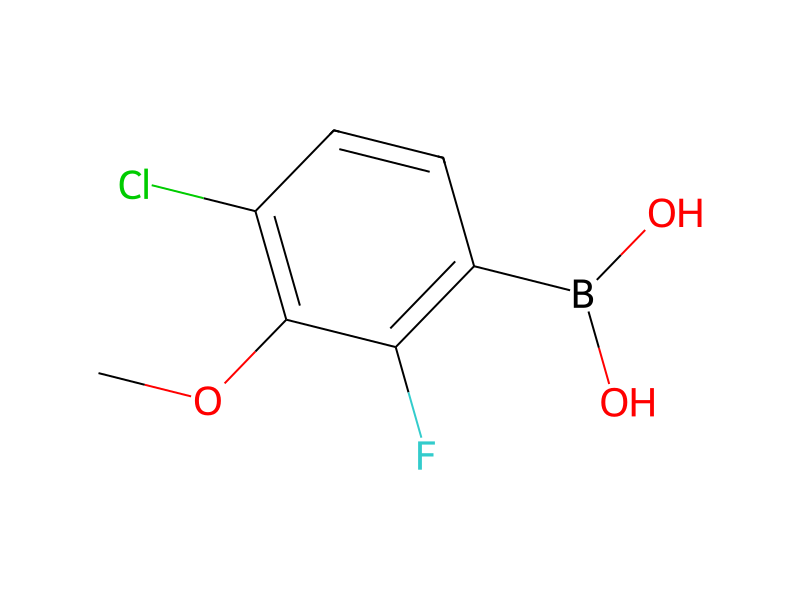
Hydrochloric Acid → 4-Chloro-2-fluoro-3-methoxyphenylboronic acid
Reaction equation

[Cl:1][C:2]1[CH:7]=[CH:6][C:5]([B-:8](O)([OH:10])[OH:9])=[C:4]([F:12])[C:3]=1[O:13][CH3:14].[K+].Cl>>[Cl:1][C:2]1[CH:7]=[CH:6][C:5]([B:8]([OH:9])[OH:10])=[C:4]([F:12])[C:3]=1[O:13][CH3:14]Participants


Procedure
Another embodiment of the present disclosure includes a method of forming 2-(4-chloro-2-fluro-3-methoxylphenyl)-4,4,5,5-tetramethyl-1,3,2-dioxaborolane that comprises contacting 2-chloro-6-fluoroanisole with n-butyl lithium to form 6-chloro-2-fluoro-3-lithioanisole. The 6-chloro-2-fluoro-3-lithioanisole may be contacted with trimethyl borate to form dimethyl 4-chloro-2-fluoro-3-methoxyphenylboronate. The dimethyl 4-chloro-2-fluoro-3-methoxyphenylboronate may be reacted with aqueous potassium hydroxide to form potassium (4-chloro-2-fluoro-3-methoxyphenyl)trihydroxyborate. The potassium (4-chloro-2-fluoro-3-methoxyphenyl)trihydroxyborate then may be reacted with aqueous hydrochloric acid to form 4-chloro-2-fluoro-3-methoxyphenylboronic acid. The 4-chloro-2-fluoro-3-methoxyphenylboronic acid may be reacted with 2,3-dimethyl-2,3-butanediol.
Sources & evidence
- ORD record
- ord-c9ba841055d04703b9b4ffcaf656b223
- Source dataset
- uspto-grants-2016_08
- Patent number
- US09422313B2
Reaction notes
Loading…