Phosphoric Acid → (2R,3S,4R,5R)-2,3,4,5,6-pentahydroxyhexanal
Reaction equation

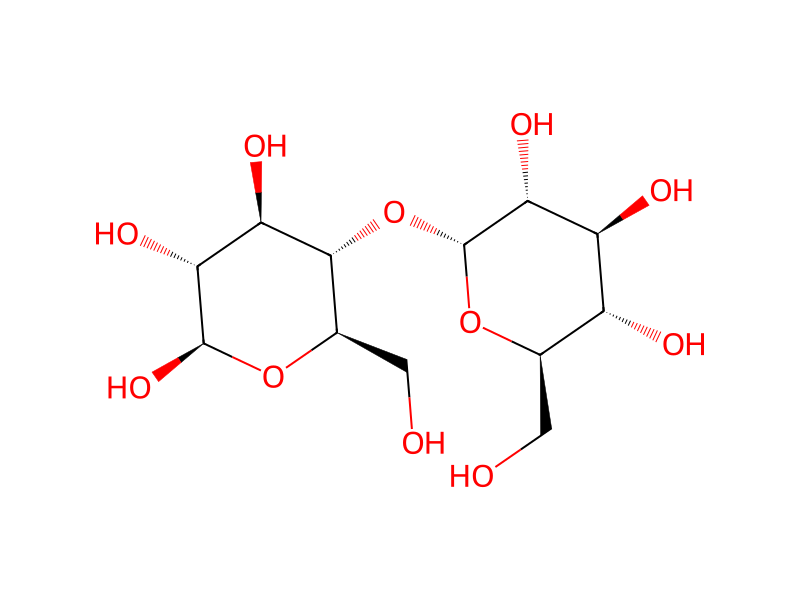
P(=O)(O)(O)O.[Cl-].[Na+].[CH2:8]([OH:30])[C@H:9]1[O:14][C@H:13]([O:15][C@H]2[C@H](O)[C@@H](O)[C@H](O)O[C@@H]2CO)[C@H:12]([OH:27])[C@@H:11]([OH:28])[C@@H:10]1[OH:29]>O>[O:15]=[CH:13][C@@H:12]([C@H:11]([C@@H:10]([C@@H:9]([CH2:8][OH:30])[OH:14])[OH:29])[OH:28])[OH:27]Participants
Reactant 3


Product 1

Reagents, catalysts & solvents 1

Procedure
To 1 ml of a buffer solution (pH 6.5) containing 20 mM phosphoric acid and 6.7 mM sodium chloride, 300 mg of maltose (Wako Pure Chemical Industries Ltd. product) was dissolved, and then, 10 mg of α-amylase (saccharification type, Seikakagaku Corporation product by using Bacillus subtilis) and 1 mg of ε-poly-L-lysine were added and dissolved. The spores of Bacillus cereus (equivalent to 103 colony-forming units) were inoculated to the solution and allowed to react at 60° C. for 24 hrs. After the reaction was completed, the reaction solution was heated in a boiled water to stop the enzyme reaction, and filtered through a 0.45 μm membrane filter. The quantity of glucose in the filtrate was measured by a high speed liquid chromatographic method (column: Showa denko K.K. product, #SC1011). The quantity of glucose thus obtained was 260 mg.
Workup
- dissolutionwas dissolved
- dissolutiondissolved
- customto react at 60° C. for 24 hrs
- customthe enzyme reaction
- filtrationfiltered through a 0.45 μm membrane
- filtrationfilter
Sources & evidence
- ORD record
- ord-001561c9c331415eb86690953e126c51
- Source dataset
- uspto-grants-1997_10
- Patent number
- US05674726
Reaction notes
Loading…