3,5-Dichlorophenyl isocyanate → 3,5-Dichloroaniline
Reaction equation

CC(N(C)C)=O.[Li+].[Cl-].[Cl:9][C:10]1[CH:11]=[C:12]([N:17]=C=O)[CH:13]=[C:14]([Cl:16])[CH:15]=1>N1C=CC=CC=1>[Cl:9][C:10]1[CH:11]=[C:12]([CH:13]=[C:14]([Cl:16])[CH:15]=1)[NH2:17]Participants
Reactant 2
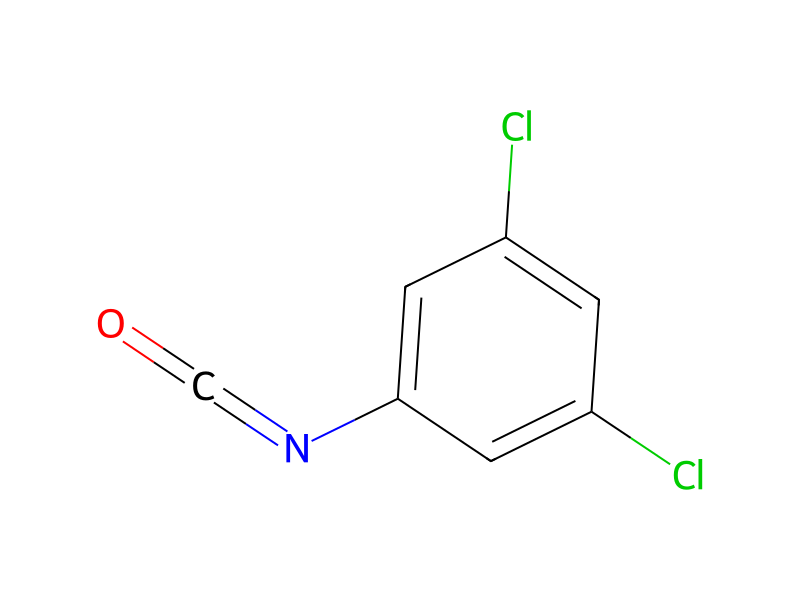

Product 1
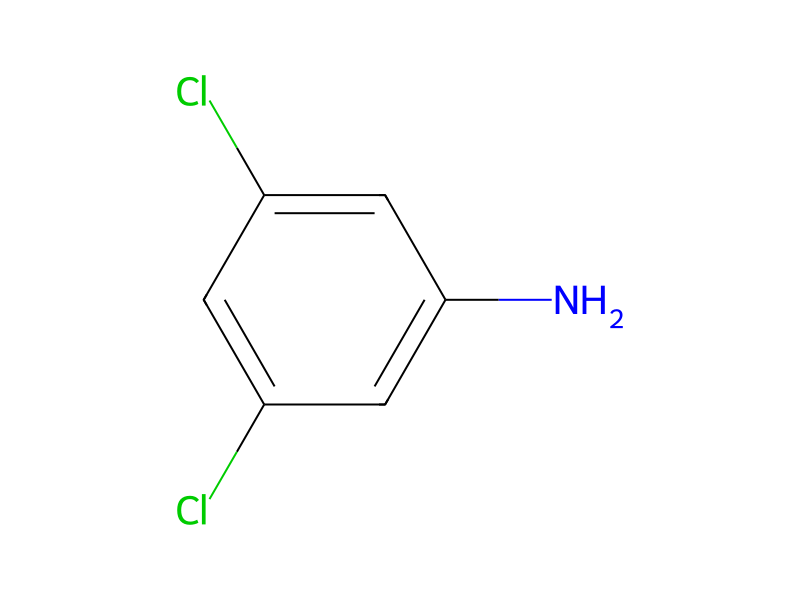
Reagents, catalysts & solvents 1

Procedure
The polysaccharide-conjugated silica gel was dispersed into a mixture of 8 ml of anhydrous DMA-LiCl and 3 ml of pyridine, and 5 g of 3, 5-dichlorophenyl isocyanate (this was formed from 3,5-dichloroaniline by an ordinary method) dissolved in 5 ml of DMA were added thereto and allowed to react at 80° C. for 12 hours under nitrogen, whereby the hydroxyl groups in the saccharide moiety that had been chemically bonded to the surface of the silica gel were modified. The presence of excess isocyanate groups in the reaction mixture was confirmed by the peak of C=N stretching vibration at 2,270 cm-1 in the IR spectrum of the solution. The polysaccharide derivative-conjugated silica gel in the reaction mixture was washed with tetrahydrofuran, methanol, acetone and hexane to remove impurities therefrom and then dried in vacuum at 60° C. for 2 hours. Then, the compound was analyzed by IR spectrography and elementary analysis (see Table 1).
Sources & evidence
- ORD record
- ord-0763a87c1a364316a887d3134dec6ae7
- Source dataset
- uspto-grants-1997_10
- Patent number
- US05679572
Reaction notes
Loading…