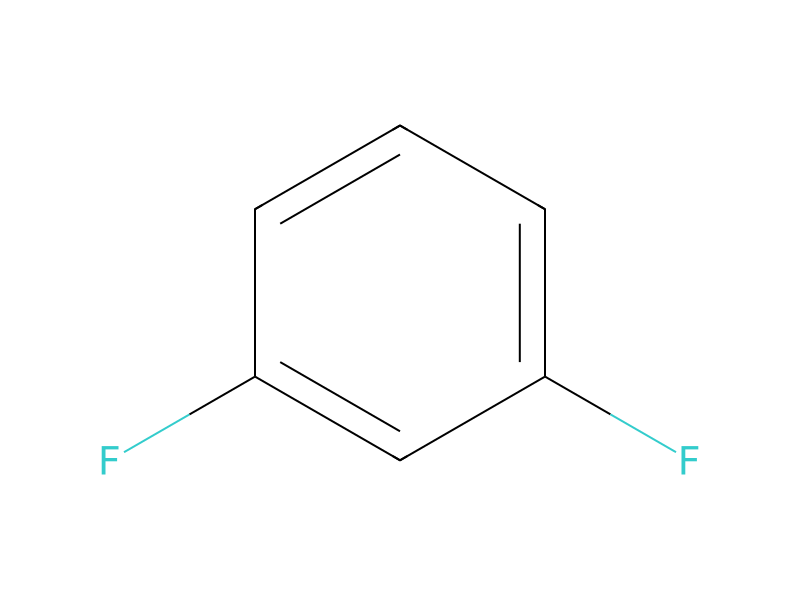
Sulfuric Acid → 1,3-Difluorobenzene
Reaction equation

[S:1](=[O:5])(=[O:4])([OH:3])[OH:2].[F:6][C:7]1[CH:13]=[C:12]([F:14])[CH:11]=[CH:10][C:8]=1[NH2:9].O[PH2]=O.N([O-])=O.[Na+]>O>[S:1]([OH:5])([OH:4])(=[O:3])=[O:2].[F:6][C:7]1[CH:13]=[C:12]([F:14])[CH:11]=[CH:10][C:8]=1[NH2:9].[F:6][C:7]1[CH:8]=[CH:10][CH:11]=[C:12]([F:14])[CH:13]=1Participants
7
Reactant 4




Product 2

Reagents, catalysts & solvents 1

Procedure
2,4 Difluoroaniline sulfate was prepared by mixing 62.6 g (2.5 molar proportions) of 98% sulphuric acid with 32.3 g (0.25 mole) of 2,4-difluoroaniline in a three neck flask. 66 g (2.0 molar proportions) of 50% H3PO2 aqueous solution were added and the slurry was allowed to warm to 50° C.±5° C. Then 18.3 g (1.1 molar proportion) of sodium nitrite dissolved into 30 g of water were added drop by drop, while the temperature was kept at 50° C.±5° C. After 1 hour 30 minutes for the complete addition, only 3.2 liter of gas had been evolved (Theory [~6.3 l). The reaction mixture was worked up as in Example 1 (decantation, extraction, distillation). Only 7.7 g of 1,3-difluorobenzene (yield=27%) were obtained.
Workup
- temperatureto warm to 50° C.±5° C
- additionwere added drop by drop
- customwas kept at 50° C.±5° C
- extractionThe reaction mixture was worked up as in Example 1 (decantation, extraction, distillation)
Sources & evidence
- ORD record
- ord-9b474a0a78dc4cc99567d0eec2c6448f
- Source dataset
- uspto-grants-1997_10
- Patent number
- US05679879
Reaction notes
Loading…