1,4-Dibromobenzene → 2-(2,5-Dibromophenyl)-4,4,5,5-tetramethyl-1,3,2-dioxaborolane
Reaction equation

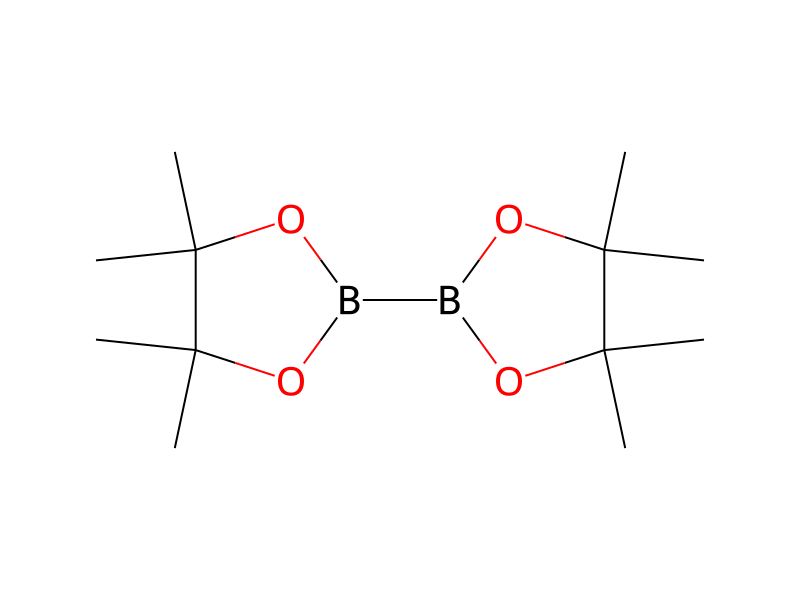
Brc1ccc(Br)cc1>C1=CCCC=CCC1.C1=CCCC=CCC1.CC1(C)OB(B2OC(C)(C)C(C)(C)O2)OC1(C)C.COC1CCCC1.C[OH2+].C[OH2+].[Ir].[Ir].c1ccc(N2B(B3Nc4ccccc4N3c3ccccn3)Nc3ccccc32)nc1>CC1(C)OB(c2cc(Br)ccc2Br)OC1(C)CParticipants
6
Reactant 1

Product 1

Reagents, catalysts & solvents 4


Conditions
- Temperature
- 100 °C
Procedure
The general procedure A was followed using 1,4-dibromobenzene (118.0 mg, 0.5 mmol) and B2pin2 (126.9 mg, 0.5 mmol, 1.0 eq.) as starting material. The resulting mixture was allowed to stir 16 hours at 100 oC. The 1H NMR conversion was 90% and the byproducts were 2,6-di- and 2,5-di- borylated products. The 1H NMR yields of 5ac, 2,6-di- and 2,5-di- borylated products were 67%, 12% and 12% respectively. 5ac was obtained as white solid (112.0 mg, 62%) after purification by silica gel flash chromatography (EtOAc/PE=1:100 v/v). m.p.: 54-56 oC.
Sources & evidence
- ORD record
- ord-066c508c5a254808b5bb566fd4b02a47
- Source dataset
- Borylation dataset from Roche
Reaction notes
Loading…