反应详情
EQUATION
反应方程式

REACTANTS
反应物
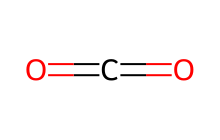
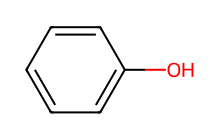
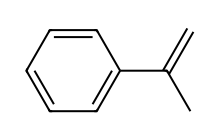
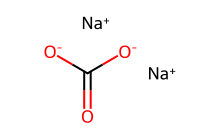
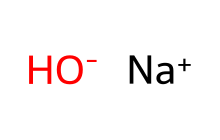
PRODUCTS
产物

AUXILIARIES
试剂、催化剂与溶剂
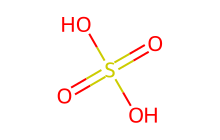

CONDITIONS
反应条件
- 温度
- 50 °C
PROCEDURE
实验过程
Charged in a reactor equipped with a thermometer, reflux condenser, dropping funnel and stirrer were 9.4 g of phenol and 0.2 g of sulfuric acid. Then, 23.6 g of α-methylstyrene was added dropwise under stirring at 50° C. from a dropping funnel. After completion of the dropwise addition, the reaction mixture was aged for 5 hours and then poured into a dilute aqueous solution of sodium carbonate. The resultant mixture was separated to obtain an oil layer. The oil layer was then distilled in vacuo. At a vacuum level of 3-4 mmHg, 22 g of a fraction having a boiling point of at least 220° C. was obtained. Thereafter, 7.5 g of a 40% aqueous solution of caustic soda was added to the fraction, followed by dehydration under reflux of xylene. After the dehydration, the xylene mixture was transferred to an autoclave and carbon dioxide was then charged to 30 kg/cm2 at 160° C. The contents were then reacted for 5 hours at the same temperature. After the reaction, the autoclave was cooled, the remaining gas was purged, the reaction mixture was extracted with hot water and the extract was neutralized with dilute sulfuric acid. As a result, crystals were caused to precipitate. Those crystals were then collected by filtration, followed by recrystallization from an aqueous acetic acid solution to obtain 8 g of 3,5-di(α,α-dimethylbenzyl)salicylic acid. A zinc salt was produced from the salicylic acid compound in the same manner as in Example 1. Using the zinc 3,5-di(α,α-dimethylbenzyl)salicylate thus produced, color-developing sheets were obtained in the same manner as in Example 1.
WORKUP
后处理
- additionCharged in a reactor
- customequipped with a thermometer
- temperaturereflux condenser
- additionAfter completion of the dropwise addition
- customThe resultant mixture was separated
- customto obtain an oil layer
- distillationThe oil layer was then distilled in vacuo
- customwas obtained
- additionwas then charged to 30 kg/cm2 at 160° C
- customThe contents were then reacted for 5 hours at the same temperature
- customAfter the reaction
- temperaturethe autoclave was cooled
- customthe remaining gas was purged
- extractionthe reaction mixture was extracted with hot water
- customto precipitate
- filtrationThose crystals were then collected by filtration
- customfollowed by recrystallization from an aqueous acetic acid solution