Chloroacetyl chloride → 4-(2-chloroacetyl)-1H-pyrrole-2-carbaldehyde
Reaction equation

[NH:1]1[CH:5]=[CH:4][CH:3]=[C:2]1[CH:6]=[O:7].[Cl-].[Al+3].[Cl-].[Cl-].[Cl:12][CH2:13][C:14](Cl)=[O:15]>ClC(Cl)C>[CH:6]([C:2]1[NH:1][CH:5]=[C:4]([C:14](=[O:15])[CH2:13][Cl:12])[CH:3]=1)=[O:7]Participants
Reactant 3

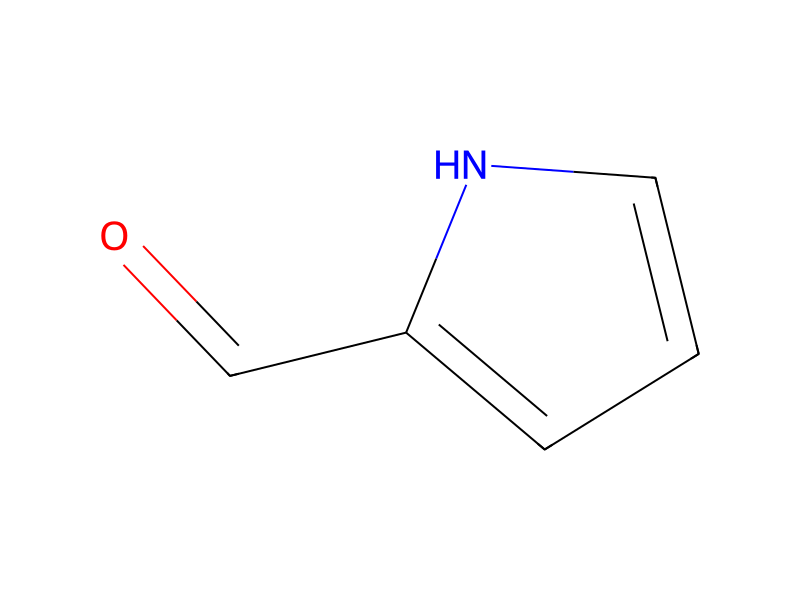

Product 1

Reagents, catalysts & solvents 1

Procedure
A mixture of 35 g (0.37 mole) pyrrole-2-carboxaldehyde in 325 ml dichloroethane was stirred under nitrogen in a three-necked, one-liter, round-bottomed flask fitted with an overhead stirrer and addition funnel. To this was added, in portions over a one-hour period, 294 g (2.21 mole) aluminum chloride. After the addition was completed, the mixture was stirred at room temperature for 10 minutes, then 124.7 g (88 ml, 1.10 mole) of chloroacetyl chloride was added dropwise over a one-hour period. The mixture was stirred at room temperature for 16 hours, then carefully poured into one liter of ice-water. The resulting precipitate (purple) was collected, washed well with water, and dried in vacuo. The dry solid was placed in a Soxhlet extractor and extracted with ethyl acetate for 20 hours. Concentration of the ethyl acetate solution afforded 59.4 g (94%) of the title compound as a yellow-green solid; m.p. 178°-179° C. This intermediate was used immediately in the next step. An analytical sample could be prepared by recrystallization from acetone.
Workup
- customfitted with an overhead stirrer and addition funnel
- additionTo this was added, in portions over a one-hour period
- additionAfter the addition
- stirringthe mixture was stirred at room temperature for 10 minutes
- stirringThe mixture was stirred at room temperature for 16 hours
- customThe resulting precipitate (purple) was collected
- washwashed well with water
- customdried in vacuo
- extractionextracted with ethyl acetate for 20 hours
Sources & evidence
- ORD record
- ord-c1002e677caa44f3a8840ae634ffae5f
- Source dataset
- uspto-grants-1991_06
- Patent number
- US05026715
Reaction notes
Loading…