Formaldehyde → Chloromethyl naphthalene-2-carboxylate
Reaction equation

C1(C(C2C=CC=CC=2)C(O[CH2:11][Cl:12])=O)C=CC=CC=1.[CH:19]1[C:28]2[C:23](=[CH:24][CH:25]=[CH:26][CH:27]=2)[CH:22]=[CH:21][C:20]=1[C:29]([OH:31])=[O:30].C(Cl)(=O)C(Cl)=O.C1C2C(=CC=CC=2)C=CC=1C(Cl)=O.C=O>[Cl-].[Zn+2].[Cl-]>[CH:19]1[C:28]2[C:23](=[CH:24][CH:25]=[CH:26][CH:27]=2)[CH:22]=[CH:21][C:20]=1[C:29]([O:31][CH2:11][Cl:12])=[O:30]Participants
7

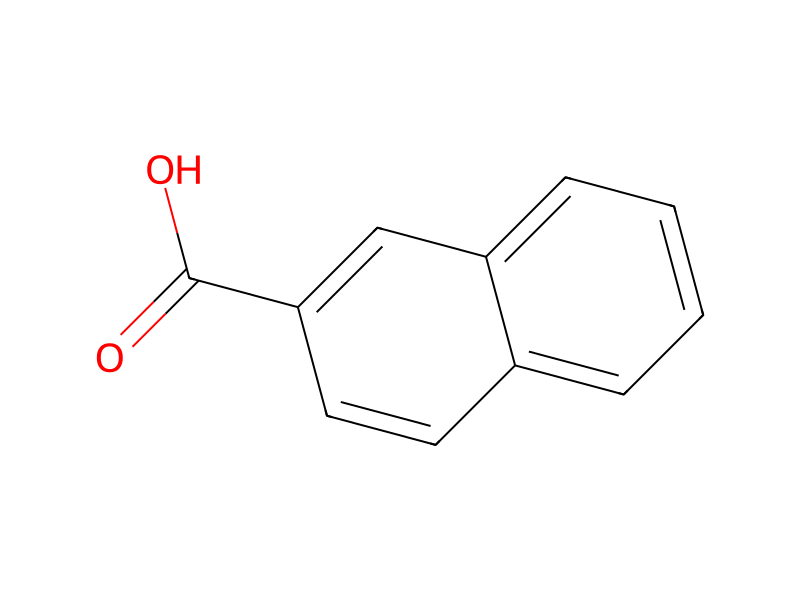




Conditions
- Temperature
- 80 °C
Procedure
A similar procedure (Lu, M. C. et al. J. Med. Chem. 1987, 30, 273-278 and Iyer, R. P. et al. Synth. Commun. 1995, 25, 2739-2749) to that described for the preparation of 50 was followed using 2-naphthoic acid (1.0 g, 5.8 mmol) and oxalyl chloride (2 mL), under reflux for 2 h. A mixture of crude 2-naphthoyl chloride, paraformaldehyde (174 mg, 5.8 mmol) and zinc chloride (6 mg, 0.04 mmol) was then stirred at 80° C. for 2 h. Purification by flash chromatography (hexane/ethyl acetate 4:1) afforded chloromethyl 2-naphthoate (53) as a colourless oil (80 mg, 0.36 mmol, 6%); 1H NMR (400 MHz, CDCl3) δ 5.98 (2H, s, CH2), 7.53-7.64 (2H, m, Ar), 7.87-7.96 (3H, m, Ar), 8.05-8.10 (1H, m, Ar), 8.65 (1H, s, Ar).
Workup
- temperatureunder reflux for 2 h
- customPurification by flash chromatography (hexane/ethyl acetate 4:1)
Sources & evidence
- ORD record
- ord-c72ebf4983324069a701ba83f888de38
- Source dataset
- uspto-grants-2015_12
- Patent number
- US09198420B2
Reaction notes
Loading…